
Choosing the right Google Display Ads targeting in-market vs custom intent strategy can decide whether your budget reaches buyers—or just browsers. This guide breaks down both options so you can match audience targeting to real campaign goals.
Every successful advertising campaign begins with one important question: Who should see your ads?
Many businesses invest heavily in advertising but overlook one of the biggest performance factors—audience targeting. At Admoon.agency, we’ve seen companies double their return on investment simply by choosing the right targeting strategy before increasing their budget.
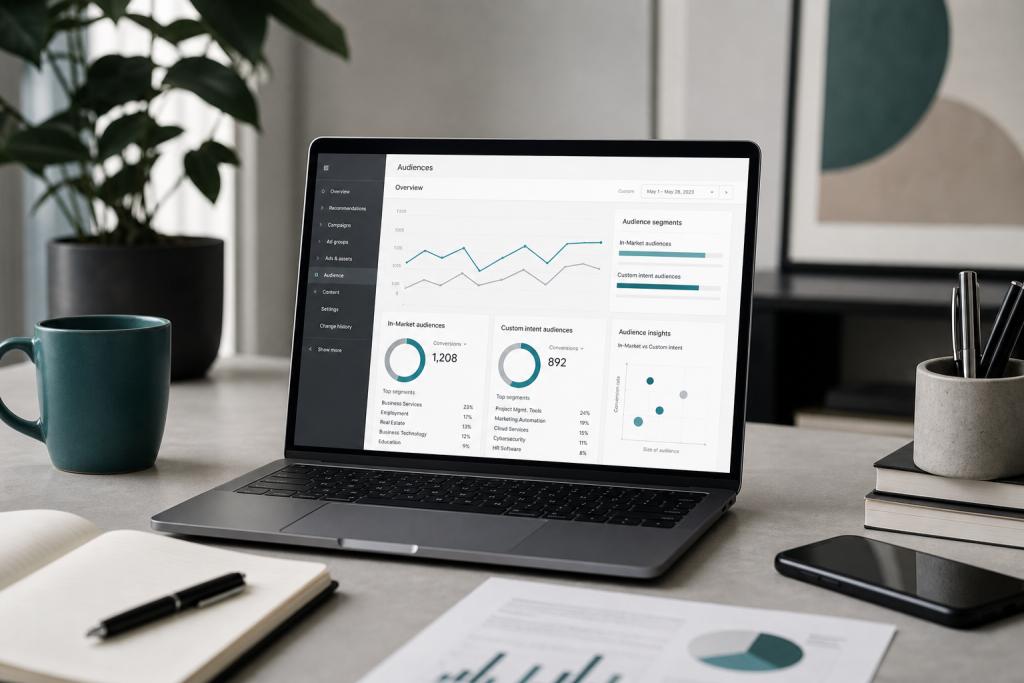
When it comes to Google Display Ads, two audience options often stand out: In-Market Audiences and Custom Intent Audiences. While both help you reach potential customers, they serve different purposes and perform differently depending on your campaign goals.
In this guide, we’ll explain the difference, when to use each one, and how experienced advertisers combine both for maximum performance in Google Ads.
Why Audience Targeting Matters in Google Display Ads
Running Google Display Ads without proper targeting is like placing a billboard in the middle of a desert. Your creativity may be excellent, but the wrong audience will never convert.
Google has access to billions of behavioral signals. It understands:
- Browsing history
- Purchase intent
- Search activity
- Content consumption
- Device usage
- Website engagement
The real advantage comes from telling Google exactly which users matter most to your business.

What Are In-Market Audiences?
In-Market audiences consist of users who Google believes are actively researching or planning to purchase a product or service.
Google identifies these users by analyzing recent behavior, including:
- Product searches
- Comparison websites
- Reviews
- Shopping activity
- Website visits
Imagine someone searching for “best CRM software,” reading multiple reviews, and comparing pricing pages. Google recognizes that person as being “in-market” for CRM software and allows advertisers to reach them through Display campaigns.
This makes In-Market targeting ideal for businesses seeking customers who are already close to making a buying decision.
What Are Custom Intent Audiences?
Custom Intent gives advertisers significantly more control.
Instead of relying entirely on Google’s predefined audience categories, advertisers create their own audience by defining:
- Keywords
- URLs
- Competitor websites
- Products
- Services
For example, a luxury real estate company can build a Custom Intent audience using keywords related to luxury villas, premium investments, and competitor property portals.
Rather than waiting for Google to categorize users, you define exactly what buying intent looks like.
Google Display Ads Targeting In-Market vs Custom Intent
Many marketers ask which option performs better.
The answer depends entirely on campaign objectives.
Google Display Ads targeting in-market vs custom intent is less about choosing one winner and more about understanding the strengths of each strategy. It influences audience quality, conversion rates, cost efficiency, and scalability. When agencies evaluate these options, they analyze buyer signals, audience relevance, business goals, and creative messaging. Successful campaigns often compare both approaches before launch, test them simultaneously, and optimize continuously—because this choice is one of the most important decisions in Display advertising.
Key Differences
Audience Source
In-Market audiences are created automatically by Google using behavioral data.
Custom Intent audiences are built manually by advertisers using keywords, URLs, and purchase signals.
Control
In-Market offers convenience.
Custom Intent offers precision.
If your niche market doesn’t fit Google’s predefined audience categories, Custom Intent provides much greater flexibility.
Scalability
In-Market audiences generally reach larger audiences.
Custom Intent campaigns often target smaller but highly qualified audiences.
Learning Phase
In-Market campaigns usually launch faster because Google has already built the audience.
Custom Intent campaigns require more testing but often deliver stronger long-term optimization.
When Should You Choose In-Market?
At Admoon.agency, we typically recommend In-Market targeting when:
- Launching a new campaign
- Building brand awareness among buyers
- Testing new products
- Working with limited audience research
- Scaling campaigns quickly
Because Google already understands buyer behavior, advertisers can often see results sooner.
When Should You Choose Custom Intent?
Custom Intent becomes the better option when:
- Selling specialized products
- Targeting B2B audiences
- Competing in niche industries
- Reaching competitor audiences
- Building highly qualified remarketing funnels
For experienced advertisers, Custom Intent usually provides greater control over lead quality.
Why Experienced Agencies Combine Both
One of our clients entered a competitive software market where every click mattered.
Instead of choosing one audience type, we launched two parallel campaigns.
The first campaign used In-Market audiences to capture broad purchase intent.
The second campaign used Custom Intent audiences based on competitor searches, industry blogs, and software review platforms.
Within six weeks:
- Cost per acquisition decreased.
- Conversion rates improved.
- Qualified leads increased.
- Display campaign ROI became significantly stronger.
This illustrates why experienced agencies rarely rely on only one audience strategy.
Best Practices for Google Display Ads
To maximize campaign performance:
- Test both audience types simultaneously.
- Create different creatives for each audience.
- Exclude irrelevant audiences regularly.
- Monitor conversion quality instead of click volume.
- Refresh audience definitions every few months.
- Pair Display campaigns with Google Search Ads for a complete customer journey.
- Expand successful campaigns with localized strategies like Google Ads Dubai Campaigns.
- Continue improving your advertising knowledge through trusted resources like Coursera.
Google Display Ads as the Foundation of Long-Term Growth
Google Display Ads remain one of the most powerful digital advertising channels because they combine advanced automation with intelligent audience targeting. Businesses that consistently improve performance understand that Display requires testing, optimization, creative refinement, audience segmentation, and continuous analysis. Whether launching new products or scaling established brands, Google Display Ads help generate awareness, nurture prospects, increase conversions, strengthen remarketing, improve customer acquisition, and build sustainable growth. Investing in smarter Google Display Ads targeting over time creates a competitive advantage that compounds with every campaign.
Final Thoughts
Choosing between In-Market and Custom Intent isn’t about finding a universal winner.
It’s about matching your audience strategy to your business objectives.
In-Market audiences help you reach people already preparing to buy.
Custom Intent audiences allow you to define exactly who your ideal customer is.
The most successful advertisers don’t debate Google Display Ads targeting in-market vs custom intent—they test, measure, and combine both strategies based on data. That’s exactly how our specialists at Admoon.agency approach every campaign, helping clients transform advertising budgets into measurable business growth.