Most fitness businesses running Google Ads don’t actually have a keyword problem—they have a relevance and intent problem. Budgets are often wasted on overly broad searches, poorly structured campaigns, and bidding strategies that don’t reflect how people actually choose a gym.
Success in fitness advertising comes down to three core elements: targeting the right search intent, selecting high-quality keywords, and applying the right bidding strategy at the right stage of campaign maturity. This guide covers fitness industry Google Ads keywords bidding in a practical framework that attracts qualified members, reduces wasted spend, and improves cost per acquisition.
Search Intent in Fitness Google Ads
Understanding search intent is the foundation of any successful fitness Google Ads strategy. Not every user searching for fitness-related terms is ready to join a gym, and treating all traffic equally is one of the most expensive mistakes in paid search—especially on Google Search Ads.
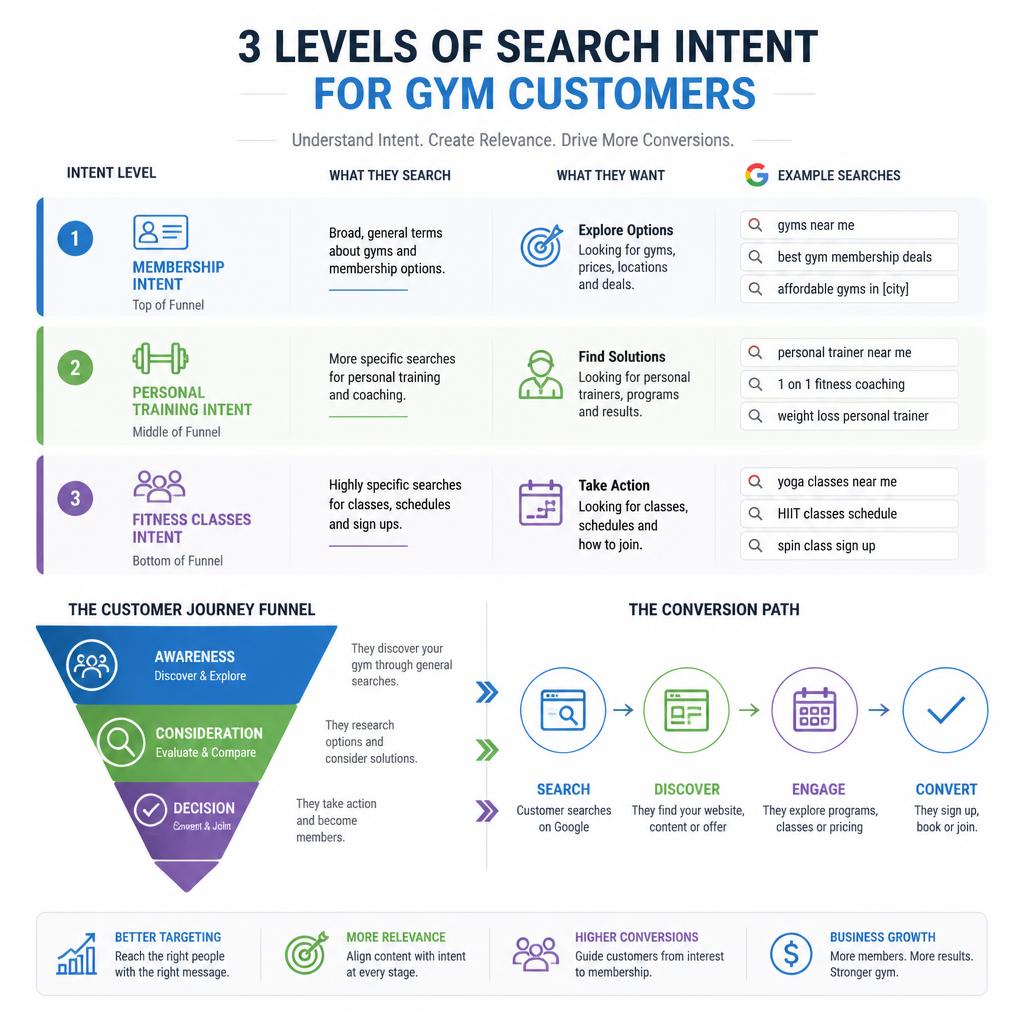
There are three primary intent categories:
1. Membership Intent (High Intent)
These users are actively looking to join or compare gyms and are closest to conversion. Examples: gym membership near me, join a gym today, fitness center prices near me. These should always be the highest priority in any fitness Google Ads strategy.
2. Personal Training Intent (Mid–High Intent)
Users seeking guided transformation or structured support. Examples: personal trainer near me, weight loss coach gym, 1-on-1 fitness training.
3. Class-Based Intent (Mid Intent)
Users exploring structured fitness activities. Examples: yoga classes near me, crossfit classes nearby, HIIT training gym.
A strong campaign structure separates these intent types into dedicated ad groups or campaigns to improve relevance and conversion rates.
Best Keywords for Fitness Google Ads Campaigns
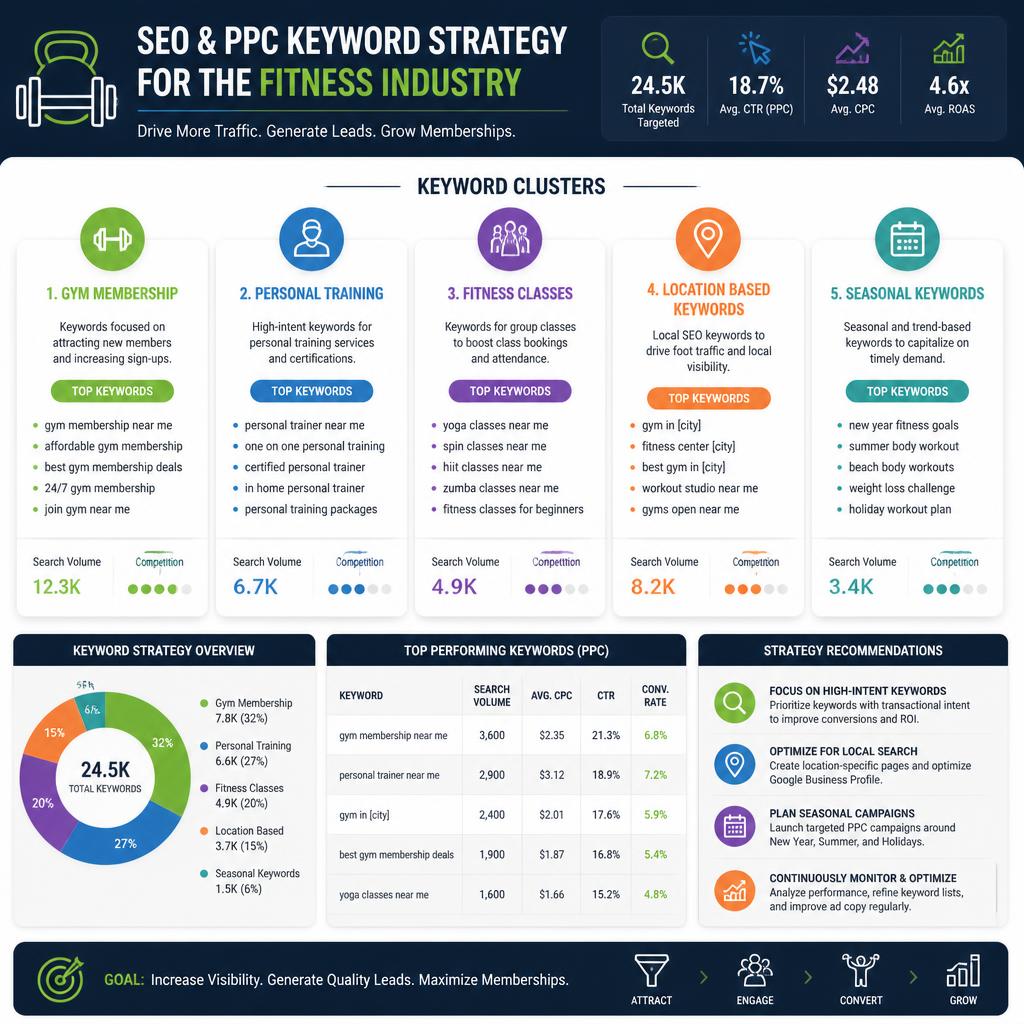
Keyword selection determines whether your campaigns scale efficiently or waste budget. In fitness advertising, commercial intent always outperforms general fitness curiosity.
Gym Membership Keywords
- gym membership near me
- affordable gym membership
- 24-hour gym near me
- best gym in [city]
Personal Trainer Keywords
- personal trainer near me
- gym personal training sessions
- weight loss trainer gym
Fitness Class Keywords
- group fitness classes near me
- HIIT workout classes
- yoga gym classes
Location-Based Keywords
- gym near me open now
- fitness center near [location]
- closest gym to me
Seasonal Keywords
- new year gym membership
- summer body workout gym
- back to fitness program
Long-tail keywords consistently outperform broad terms because they indicate stronger intent and lower competition, making them essential for efficient scaling.
Negative Keywords Strategy
One of the most common reasons fitness campaigns fail is irrelevant traffic caused by missing negative keywords. A well-structured campaign must exclude non-commercial searches such as:
- home workout programs
- gym equipment for home
- protein supplements
- fitness jobs
- physical therapy exercises
Without proper negative keyword filtering, campaigns attract users who are unlikely to convert into paying members, leading to inflated costs and poor ROI.
Keyword Match Types for Fitness Campaigns
Match types determine how Google interprets and expands your targeting.
Broad Match
Useful for discovery but requires strict control. Without negative keywords, it can quickly become inefficient.
Phrase Match
The best balance between reach and control for most fitness campaigns.
Exact Match
Highest precision and strongest conversion performance. Ideal for scaling proven keywords.
Recommended Structure
A balanced fitness Google Ads setup typically follows: 60% Phrase Match, 25% Exact Match, and 15% Broad Match (with strong negative keyword coverage). This structure ensures both scalability and efficiency.
Fitness Industry Google Ads Keywords Bidding Strategies
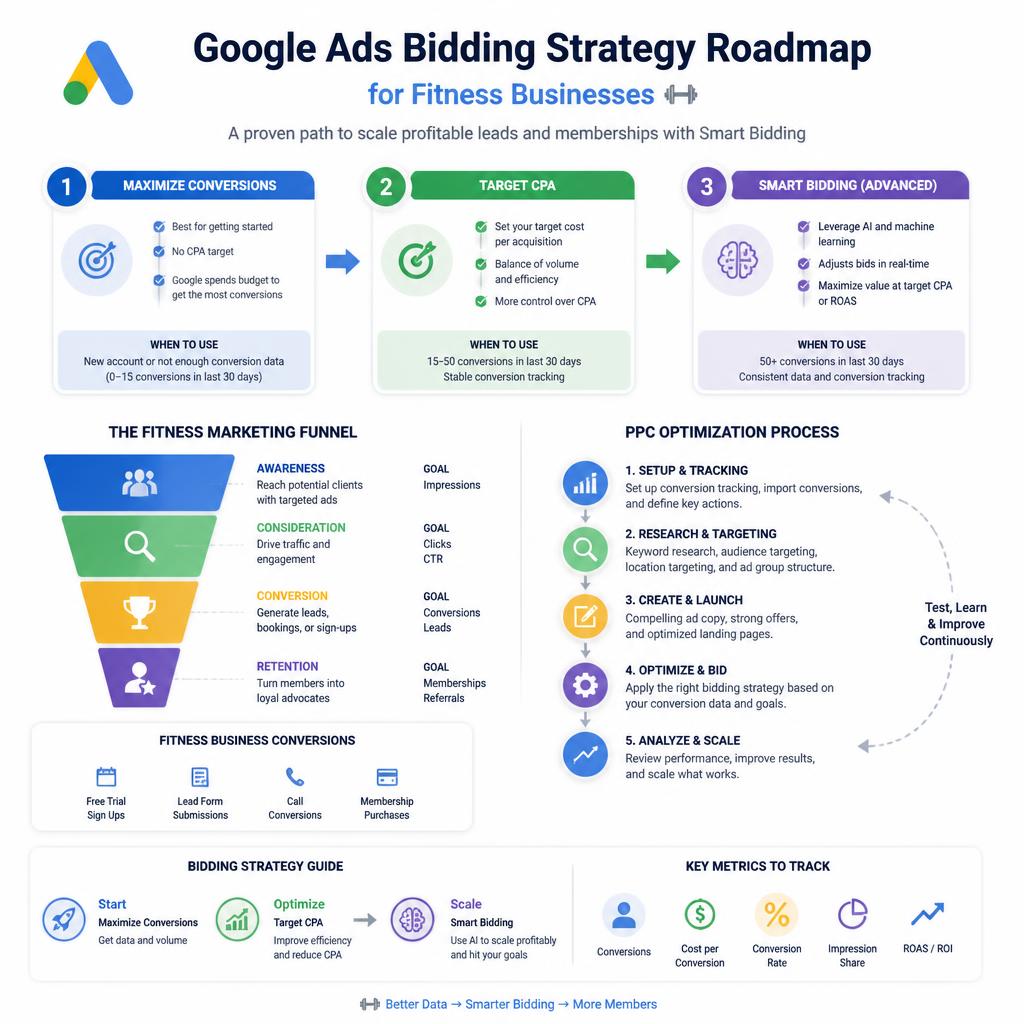
Bidding is where many fitness campaigns either scale profitably or lose control of costs. Your bidding strategy should always reflect the maturity of your account and available conversion data—something an experienced Google Ads agency tunes as conversion volume grows.
Maximize Conversions
Best for new campaigns with limited data. Google optimizes bids to generate conversion volume.
Target CPA (Cost Per Acquisition)
The most stable and widely used strategy once sufficient conversion data is available. Ideal for consistent lead generation.
Manual CPC
Useful for early testing and keyword discovery but not suitable for long-term scaling.
Smart Bidding
Uses machine learning to adjust bids in real time based on conversion probability, improving efficiency at scale.
When to Transition Strategies
- Start: Maximize Conversions
- After 20–30 conversions: Target CPA
- Mature accounts: Smart Bidding optimization
A successful campaign evolves its bidding strategy based on data—not assumptions. If performance stalls after the transition, a focused Google Ads tune-up can reset bids, negatives, and tracking before you scale spend again.
Local Targeting & Proximity Strategy
Fitness is inherently local. Most users will not travel far for a gym unless it offers a highly unique value proposition. Effective local strategies include radius targeting (3–8 km in urban areas), bid adjustments for “near me” searches, mobile-first optimization, and higher bids in high-income or high-density zones.
Most conversions come from mobile users searching in real time, making proximity targeting a critical performance factor for gyms and studios—including industry-specific setups covered on our industry solutions page.
Seasonal Budget Strategy
Demand in the fitness industry is highly cyclical rather than constant. Key seasonal peaks include January (New Year resolutions), April–June (summer preparation), and September (routine reset season).
A strong strategy increases budgets during high-intent periods and reduces inefficient spending during low-demand months. Ignoring seasonality typically leads to higher CPCs and lower conversion efficiency.
Common Mistakes in Fitness Google Ads
Most underperforming campaigns share the same structural issues:
- Over-reliance on broad keywords like “gym”
- Lack of negative keyword strategy
- Missing or incomplete conversion tracking
- Weak or generic offers with low differentiation
- Premature use of advanced bidding strategies
The most critical mistake is treating all search traffic as equal—intent varies significantly and must be segmented accordingly.
Conclusion
Success in fitness advertising is not about increasing spend—it’s about improving structure. A high-performing fitness Google Ads strategy is built on intent-based keyword segmentation, strong negative keyword filtering, controlled match type strategy, data-driven bidding optimization, and local and seasonal targeting.
When these elements work together, Google Ads becomes a predictable and scalable member acquisition channel rather than an unpredictable cost center. If you want help applying this fitness industry Google Ads keywords bidding framework, start with an audit of keyword structure, bidding, and conversion tracking—then rebuild around search intent rather than search volume.
Frequently Asked Questions
What are the best keywords for fitness Google Ads?
High-intent keywords such as “gym membership near me,” “personal trainer near me,” and location-based searches consistently deliver the strongest conversion performance because they reflect purchase-ready users.
Which bidding strategy works best for gym advertising?
Target CPA is typically the most effective strategy once enough conversion data is available. For new campaigns, Maximize Conversions is recommended to accelerate data collection.
How much budget do gyms need for Google Ads?
Budget requirements vary by market, but most gyms need sufficient spend to generate at least 20–30 conversions per month for effective optimization and reliable bidding performance.
What is the most common mistake in fitness PPC campaigns?
The most common mistake is using overly broad keywords without proper negative keyword filtering, which leads to irrelevant traffic and wasted ad spend.