
Display advertising has become significantly more automated over the last few years. AI now selects headlines, images, combinations, and placements automatically, making campaign creation much faster than traditional creative workflows.
Yet many advertisers still ask the same question: Should you use Responsive Display Ads or invest in fully custom display creatives?
When evaluating responsive display ads vs custom creatives, performance marketers must balance operational efficiency with brand presentation. This guide compares both formats across performance, scalability, branding, and conversion potential so you can choose the right approach for 2026—whether you work with an Adwords agency or manage creatives in-house.
What Are Responsive Display Ads?
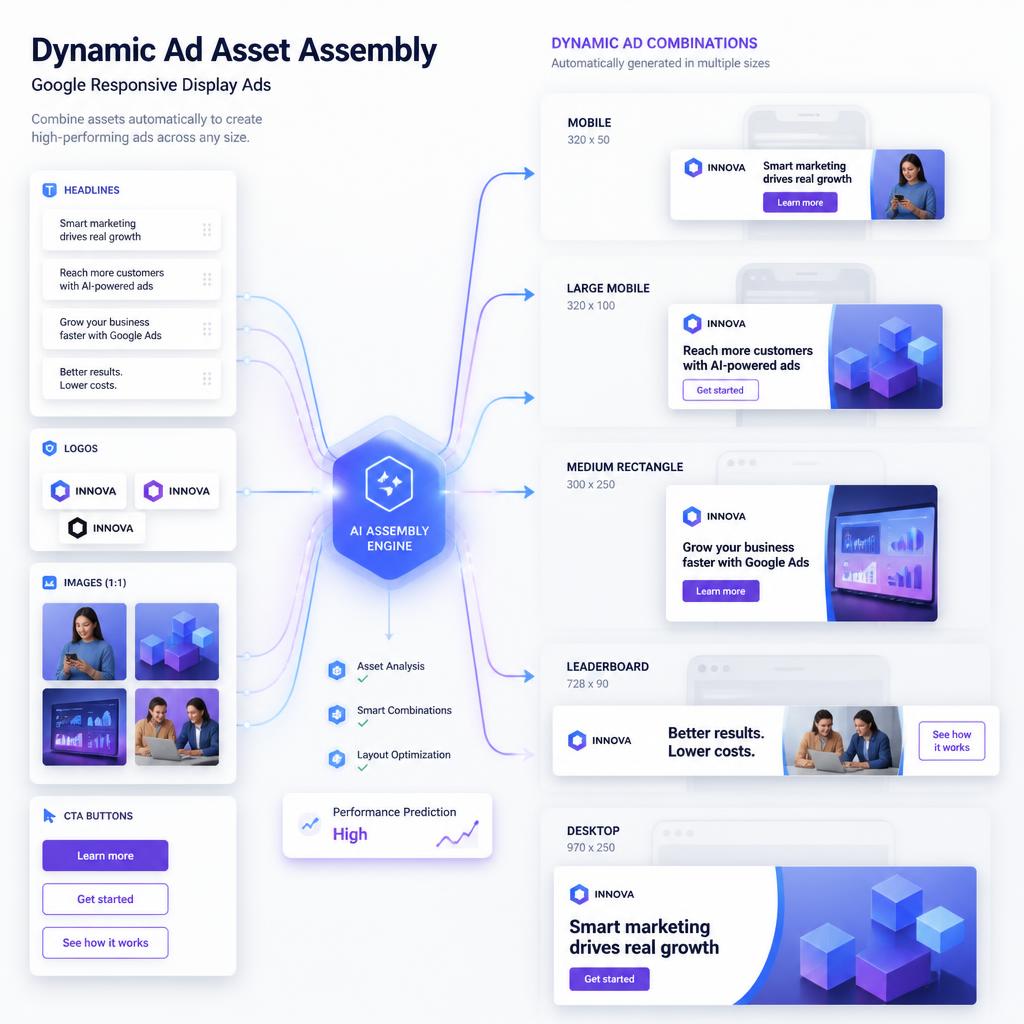
Responsive Display Ads (RDAs) let advertisers upload multiple assets—including headlines, descriptions, logos, images, and videos—while Google automatically creates different combinations for eligible placements across the Display Network.
Instead of designing dozens of banner sizes manually, you provide assets once and Google’s machine learning assembles relevant versions in real time. For teams scaling multiple campaigns, RDAs are often the quickest path using a complete Google Display Ads setup without building every dimension by hand.
Key Benefits of RDAs
- Automatic resizing across web, apps, Gmail, and YouTube placements
- Faster campaign launches
- Continuous asset optimization
- Broader inventory coverage, including native slots
- Lower creative production overhead
What Are Custom Display Creatives?
Custom creatives are manually designed banner ads built in specific dimensions such as 300×250, 728×90, 160×600, or 300×600. Every image placement, headline choice, CTA, animation frame, and visual element is intentionally designed by a human—not assembled by an algorithm.
Key Benefits of Custom Banners
- Exact brand identity and guideline compliance
- Fixed messaging without awkward AI cropping or truncation
- Designer-controlled visual hierarchy
- Rich HTML5 animation and storytelling
- Premium presentation for luxury and high-ticket offers
When Responsive Display Ads Perform Better
RDAs excel when efficiency, testing speed, and reach matter most—especially if you need to launch quickly, have limited design resources, manage large e-commerce catalogs, refresh offers often, or optimize primarily for conversion volume at scale.
Google continuously evaluates asset combinations and prioritizes stronger performers, which helps a google ads agency dubai improve results without rebuilding every banner from scratch.
When Custom Creatives Still Win
Custom creatives still outperform when brand identity is non-negotiable, complex products need visual storytelling, launches require uniform messaging, or luxury and premium categories demand flawless presentation. In crowded markets, designed visuals often communicate emotion and trust more effectively than auto-assembled ads.
Which Format Generates Better Conversions?
Conversion performance depends on audience intent, landing page alignment, offer strength, tracking accuracy, and bidding—not format alone. RDAs often generate higher total conversion volume in large prospecting campaigns because they enter low-cost native placements static banners can’t. Custom creatives often achieve higher conversion rates on high-intent remarketing audiences where visual quality influences trust.
The Best Strategy in 2026: The Hybrid Approach
- Test with RDAs first to gather broad performance data quickly
- Analyze Asset Performance reports to isolate winning hooks
- Refine winners into custom HTML5 or static banners
- Scale both side-by-side—RDAs for reach, custom for high-intent placements
This hybrid workflow balances automated scalability with creative excellence. Clean tracking and account structure—including setups where teams rent google ads account environments—make asset testing far more trustworthy.
Creative Best Practices Regardless of Format
Focus on one clear value proposition, maintain strong visual hierarchy, design mobile-first, use explicit CTAs, and keep offer messaging consistent with the landing page. If performance stays weak after testing both formats, review structure and conversion setup with a thorough Google Ads audit before overhauling creatives again—support many growth teams expect from a full-service Google Ads agency.
Conclusion
Automation changed display advertising, but strategy and design still matter. Responsive Display Ads make management faster and more scalable, while custom creatives offer unmatched brand fidelity. The strongest 2026 accounts use both—letting automation uncover winning hooks and custom design maximize conversion impact.
Frequently Asked Questions
Are Responsive Display Ads replacing custom banner ads completely?
No. Responsive Display Ads simplify campaign creation and scale, but custom banners remain essential for brands requiring strict visual compliance, animated HTML5 features, and bespoke design layouts.
Do Responsive Display Ads convert better than custom banners?
RDAs often generate a higher volume of conversions due to broader inventory reach and dynamic optimization. Custom banners frequently yield higher conversion rates on targeted remarketing lists where visual quality drives trust.
Should small businesses start with Responsive Display Ads?
Yes. Businesses with limited design bandwidth can launch immediately with RDAs while taking advantage of Google’s machine learning asset optimization.
Can I run both RDAs and Custom Creatives in the same campaign?
Yes. Running both formats allows Google to enter more placement auctions while giving your account both automated scalability and controlled brand messaging.