
A few months ago, a retail client came into an audit call quietly frustrated. Their performance max campaigns were spending fast, conversions looked acceptable, and Google kept labeling everything “Good.” On the surface, nothing was obviously wrong.
But profitability was sliding every week.
We opened the account and found the problem in under twenty minutes. One asset group. Thirty-six products. Three audience signals. Zero structure. Google was trying to serve everything to everyone — and learning nothing useful in the process.
That single structural mistake was quietly costing them five figures a month.
This is what most advertisers miss about performance max campaigns: Google’s AI doesn’t reward effort. It rewards clarity. And the fastest way to improve results is to give the algorithm clean, structured input — which is exactly what serious pmax asset group optimization tips examples are designed to do.
Key Takeaway: “Good” in Google’s dashboard doesn’t always mean efficient. One asset group covering everything is almost always a structural mistake.
Why Asset Groups Are Not the Same as Ad Groups
This distinction matters more than most advertisers realise. Ad groups in Search campaigns hold keywords and ads. Asset groups inside performance max campaigns are something different entirely — they’re bundled learning environments that combine creative assets, audience signals, landing pages, and product feeds into one package that Google uses to make decisions across every placement it owns.
When that bundle is clean and coherent, Google learns fast. When it’s messy — when a skincare product sits next to a hairdryer and sits next to a handbag — the machine learning gets confused. It can’t build a clear picture of who buys what, when, or why.
That confusion shows up in your CPA. And fixing it is where real pmax asset group optimization tips examples begin.
Split by Intent, Not Just by Category
The “everything bucket” mistake
The most common error we see in performance max campaigns is grouping products by catalog structure rather than buying behavior. A brand will separate “skincare” from “makeup” and call it segmentation. But that’s not the level Google needs.
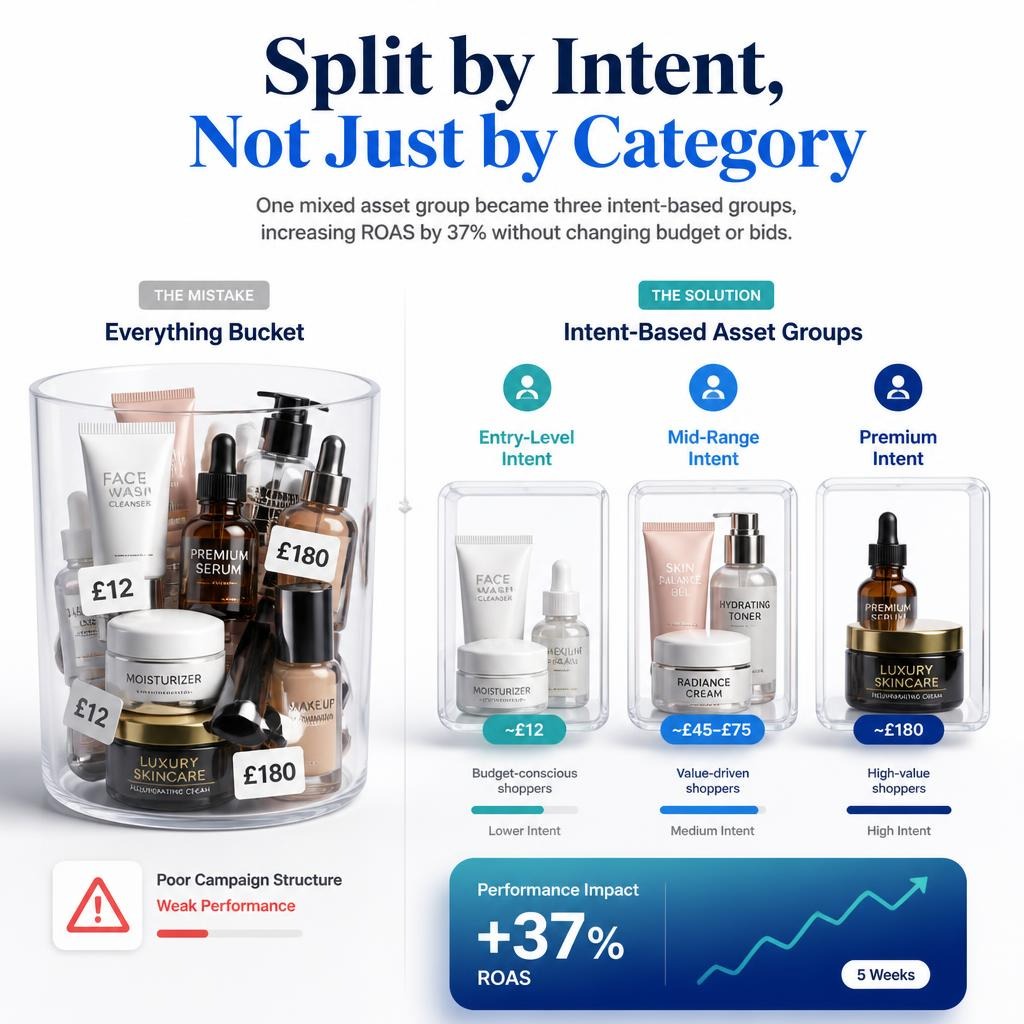
What actually matters is purchase intent. A customer browsing a £12 face wash and a customer researching a £180 serum are not the same buyer. They have different search patterns, different consideration windows, and different responses to creativity. Putting them in the same asset group asks Google to find both — and it ends up serving neither well.
A beauty brand we rebuilt this way saw a 37% ROAS improvement within five weeks. Not from changing the budget. Not from changing the bids. From splitting one asset group into three by intent tier: entry-level, mid-range, and premium. That’s one of the most practical pmax asset group optimization tips examples we apply to almost every new account.
📊 Splitting one mixed asset group into three intent-based groups produced a 37% ROAS improvement in five weeks — same budget, same products.
Creative Coverage Is the Fuel, Not the Decoration
Google automates placement inside performance max campaigns. It does not automate persuasion. That’s your job — and your assets are how you do it.
A SaaS client came to us with technically correct campaigns but starved assets: two headlines, one description, one static image, no video. Google had almost nothing to test. The algorithm defaulted to whatever it had and performance flatlined.
After expanding to twelve headlines, eight descriptions, five images, and two short videos, their CPA dropped 24% in the same month. The budget didn’t change. The audience didn’t change. The creative gave Google enough variation to find what actually worked.
This is usually the first thing a proper Google Ads Tune-Up surfaces — not because it’s the most glamorous fix, but because poor asset coverage quietly caps what the algorithm can learn. You can’t optimize what you haven’t given Google room to test.
Audience Signals Are Hints, Not Handcuffs
Vague signals create expensive exploration
There’s a misconception about audience signals in performance max campaigns that trips up even experienced advertisers: signals are not targeting. Google will go beyond them. But it uses them as a starting point for its exploration — so if your starting point is vague, the exploration gets expensive fast.
A fitness brand we audited was using “Health & Fitness Enthusiasts” as their primary signal. That’s roughly 40% of the internet. We rebuilt their signals around specific behavioral clusters: gym membership purchasers, protein supplement buyers, and fitness app users. Conversion quality improved 29% within 30 days.
The more specific your signal, the faster Google finds the right buyer. That’s one of the pmax asset group optimization tips examples that sounds simple but most brands skip because building custom audience segments takes effort. It’s worth the effort.
Testing AI Layers With Campaign Experiments
This is where sophisticated teams are quietly pulling ahead. Rather than guessing which creative angle resonates, they use structured testing to find out — and then feed those learnings back into the asset group.
We used Google Ads AI Max Campaign Testing with one e-commerce client to isolate the effect of different headline types: emotion-driven, offer-driven, and urgency-driven. Urgency outperformed by 18% across the test period. That single insight reshaped the entire campaign’s creative direction — not just one asset group.
This is where performance max campaigns stop being a black box and start becoming a structured learning system. You’re not just running ads. You’re building intelligence about your customer that compounds over time.

Landing Page Alignment Closes the Loop
Most PMax problems aren’t inside PMax
This one surprises clients. A luxury furniture brand came to us with strong assets, solid audience signals, and a well-structured product feed. Conversion rate was still weak. When we dug in, the problem was the landing page.
The asset group promised “custom-made luxury sofas.” The landing page showed a generic furniture collection with no filtering, no hero moment, and no price anchoring. Bounce rate was 71%. The performance max campaign was doing its job — it was finding the right people. The landing page was losing them.
After aligning each asset group to a dedicated landing page that matched the specific promise of the creative, conversion rate improved 33%. That’s the loop that most pmax asset group optimization tips examples don’t mention: the asset group is only as strong as where it sends people.
Key Takeaway: Asset group relevance doesn’t stop at the ad. The landing page must deliver exactly what the creative promised — or the conversion rate will tell you it doesn’t.
What the Data Actually Says About Machine Learning Quality
Coursera’s overview of Google Ads makes a point that applies directly here: machine learning systems improve proportionally with the quality of their inputs. Better data in, better decisions out. That’s not a Google-specific insight — it’s a fundamental principle of how these systems work.
Performance max campaigns are the clearest expression of that principle in Google Ads. The algorithm has access to every Google placement — Search, YouTube, Display, Gmail, Maps, Discover. That’s enormous reach. But it optimizes across all of it based on what you feed it. Weak structure produces weak learning. Strong structure produces compounding performance.
The Mistakes That Keep Performance Max Expensive
After auditing dozens of performance max campaigns, the patterns are consistent. Too many products in one asset group blurs intent signals. Identical creativity across every group removes the ability to test relevance. Broad audience signals force expensive exploration. Mismatched landing pages waste the traffic the campaign works hard to generate. And no testing cadence means the algorithm never gets the fresh input it needs to keep improving.
Each of these is fixable. None of them requires a bigger budget. All of them require structure.
What Happened to the Retail Client
We rebuilt their account into six asset groups. Not six campaigns — six structured learning environments, each with its own product set, messaging angle, audience signals, and landing page. The budget stayed identical.
Within seven weeks, profitability increased 42%.
That’s the real answer to what performance max campaigns are capable of when they’re built correctly. The automation is real. The scale is real. But neither works without the structure underneath — and structure is the one thing Google can’t build for you.
If your performance max campaigns are spending but not converting the way they should, the asset groups are almost always where the answer lives. And the fix is usually less about adding budget and more about adding clarity.
Ready to Fix Your Asset Groups?
If your performance max campaigns are marked “Good” but your profitability tells a different story, that gap usually lives inside the asset group structure. Our team audits PMax accounts every week and finds the same patterns — and we know exactly where to look. See how we approach performance max campaigns or get in touch to book a focused account review.
Frequently Asked Questions
How many asset groups should a Performance Max campaign have?
There’s no fixed number, but one is almost always too few. Start by separating products or services by intent tier — high-margin, entry-level, seasonal — rather than by catalog category. Three to six well-structured groups typically outperform one large group significantly.
Do audience signals restrict who sees my ads in PMax?
No. Audience signals are directional hints, not hard targeting. Google will go beyond them — but it uses them as the starting point for its exploration. More specific signals mean faster, cheaper learning.
How often should I refresh assets in a PMax campaign?
Every four to six weeks at minimum. Creative fatigue in performance max campaigns is real, and Google’s asset reporting shows performance ratings by individual assets. Use that data to rotate out low performers and introduce new variations regularly.
Can I run experiments inside Performance Max?
Yes — Google Ads Campaign Experiments support PMax, and they’re one of the most underused tools available. Testing creative angles, audience signals, or bidding strategies in isolation gives you clean data to make better structural decisions.