
There is a conversation that happens in almost every e-commerce account review we run at Admoon. The client points at their campaign list and asks: “We’re running Performance Max and Demand Gen — are we doing this right?” Half the time, the answer is no. Not because either campaign type is wrong, but because most teams treat them as interchangeable tools instead of distinct roles in a single system.
The debate around demand gen vs performance max for ecommerce is not really about which one is better. It is about understanding what each one is actually built to do — and then deciding which problem you are solving first. Get that sequence right and your budget works twice as hard. Get it wrong and both campaigns compete against each other for the same audience, quietly cannibalise your brand traffic, and produce a ROAS number that looks fine on paper until you turn one of them off.
This is the breakdown we wish every e-commerce brand had before launching their first performance max campaign.
At a Glance: What Each Campaign Is Actually Built For
| Performance Max | Demand Gen | |
| Goal | Conversions & revenue at scale | Awareness, interest, consideration |
| Inventory | Search, Shopping, Display, YouTube, Discover, Gmail, Maps | YouTube, Discover, Gmail |
| Audience control | Low — Google’s automation leads | High — you control placements & audiences |
| Best for | Capturing existing purchase intent | Creating new purchase intent |
| Feed required | Yes (for Shopping) | No |
| Creative format | Asset-based (text + image + video) | Visual-first (video & image heavy) |
| Reporting depth | Limited (black box) | Better audience & placement visibility |
Know Your Audience Before You Choose Your Campaign
The first question in any demand gen vs performance max for ecommerce decision is not “which gets better ROAS?” It is “where is my customer right now in their journey?”
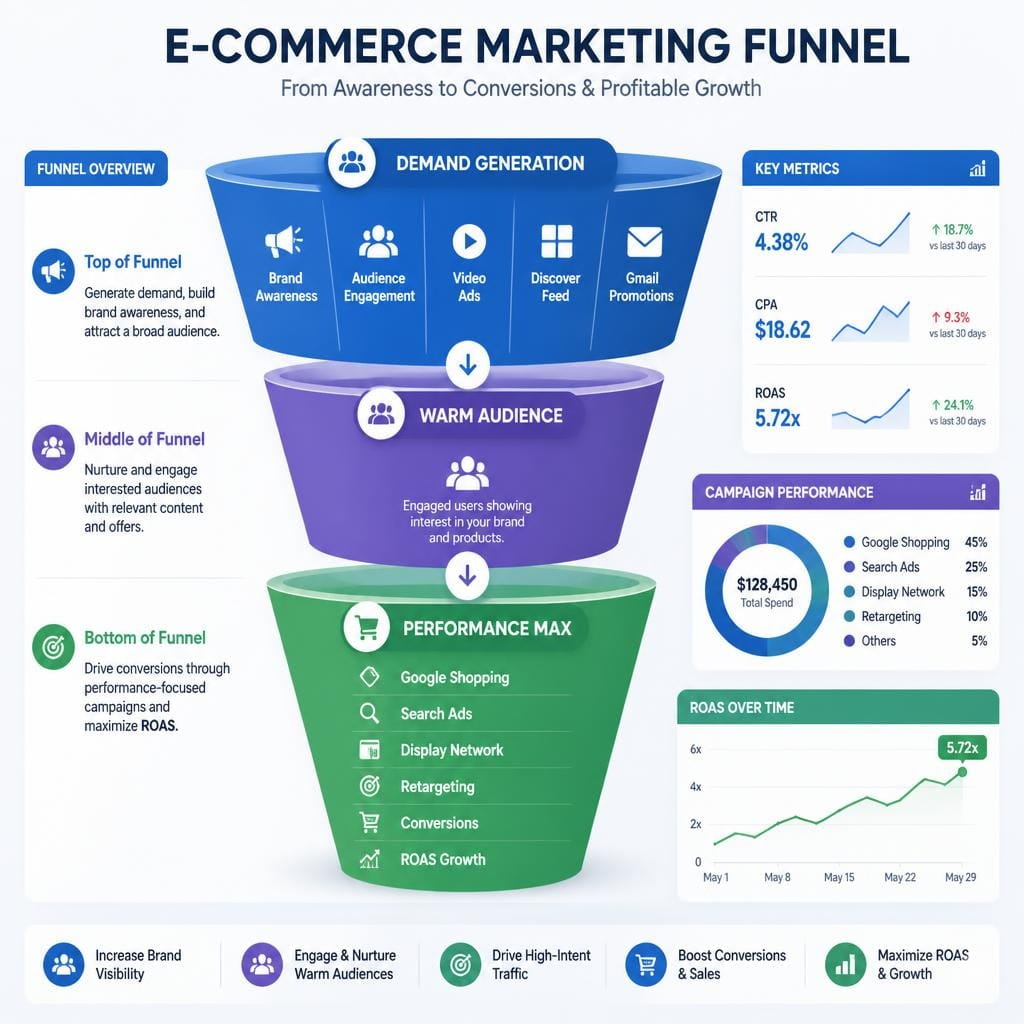
If you are selling a product in an established category — running shoes, skincare, phone cases — your customer already knows they want the thing. They are searching. They are comparing. They are one well-placed ad away from buying. That is the world performance max campaigns were built for. PMax sits at the bottom of the funnel and captures intent that already exists.
If you are launching something new, entering a market where your brand is unknown, or selling a product that needs some explanation before it converts — a niche supplement, a design-led home product, a subscription service — your customer does not know they want your product yet. You need to show them first. That is Demand Gen’s job.
Most e-commerce accounts need both. But the weight shifts dramatically depending on where you are in your growth stage. A brand in year one should probably be spending more on Demand Gen than PMax. A brand in year three with proven product-market fit should be flipping that ratio.
What Each Campaign Type Actually Does to Your Funnel
Performance Max Campaigns: Conversion Engine
Performance max campaigns work by feeding Google’s algorithm a complete asset library — headlines, descriptions, images, videos — and letting the machine decide where, when, and how to show them across every Google-owned surface. For e-commerce, PMax integrates directly with your product feed through Google Shopping Ads, dynamically matching products to purchase-intent searches in real time.
When PMax is working well, it is genuinely impressive. It finds conversion paths you would not have thought to build manually. It bids efficiently across surfaces and collapses what used to be five separate campaigns into one. For a mid-sized e-commerce brand with a solid product feed and clean conversion tracking, a well-structured performance max campaign can be one of the highest-ROAS channels in the account.
E-commerce accounts that add a product feed to Performance Max see an average 25–30% uplift in conversion value versus asset-only PMax.
Source: Google internal data, 2023. Results vary by category, budget, and feed quality.
Demand Gen: The Attention Layer
Demand Gen runs across YouTube (including Shorts), Google Discover, and Gmail — the places people go when they are not actively searching, but they are receptive. It is visually led, audience-targeted, and designed to make someone aware of a brand or product before they have thought to look for it.
For e-commerce, Demand Gen is particularly powerful for new product launches, seasonal pushes where you need to build excitement before the intent spike hits, and retargeting warm audiences with richer creative than PMax allows. The audience controls are meaningfully better — you can target by interest, life events, custom intent, and lookalikes in ways that PMax does not expose.
HubSpot’s demand generation research consistently shows that brands investing in upper-funnel awareness see lower CPAs at the bottom — because warmed audiences convert more efficiently when they reach a purchase decision.
When NOT to Use Performance Max (The Part Nobody Warns You About)
⚠ The PMax Cannibalisation Problem: If you are running branded Search campaigns alongside Performance Max without proper campaign priority settings and brand exclusions, PMax will quietly take credit for clicks your brand campaign would have captured for a fraction of the cost. We have seen accounts where 30–40% of reported PMax conversions were brand-name searches that had nothing to do with PMax’s work.
Performance max campaigns are not the right primary tool when:
- Your conversion tracking is incomplete — PMax optimises toward the signal you give it; bad data produces bad bidding
- You are launching a brand new product with zero search volume — there is no intent to capture yet
- Your creative assets are weak — PMax assembled from generic images and copy will underperform every time
- You need granular keyword control for google ads management — PMax is a black box; if your category requires precise negative keyword management, you lose that here
For a deeper look at how PMax compares to the newest campaign format, the AI Max vs Performance Max breakdown covers exactly where the lines are shifting in 2025.

The Combination That Actually Works: Sequenced Budget Strategy
Here is the honest answer to demand gen vs performance max for ecommerce: the question is a false binary. The brands seeing the strongest blended ROAS are not choosing one — they are sequencing both with intention.
Phase 1 — Build the Audience (Demand Gen)
Run Demand Gen for 4–6 weeks before a product launch or peak season. Target interest-based audiences with high-quality video creative. The goal is not conversions yet — it is warm audiences. Every view and engagement builds a retargeting pool that performance max campaigns will later convert more efficiently.
Phase 2 — Convert the Demand (Performance Max)
Layer in performance max campaigns once the awareness pool is live. Feed it the custom segment of people who engage with your Demand Gen creative. Now PMax is working with a warm audience instead of cold signals, and your conversion rates reflect that difference.
Phase 3 — Read the Signals and Rebalance
After 6–8 weeks you will have clear data: which Demand Gen audiences converted inside PMax, which creative angles drove the most engaged traffic, and where the funnel is leaking. Use that to tighten both campaigns — better audience exclusions in PMax, sharper creative targeting in Demand Gen.
A UAE fashion e-commerce brand we worked with ran this model ahead of DSS (Dubai Summer Surprises). Demand Gen ran for five weeks targeting fashion-interested audiences across the GCC. When performance max campaigns launched two weeks before the event peak, conversion rate was 2.1x higher than the previous year’s standalone PMax launch — because the audience was already warmed.
2.1x higher conversion rate when Performance Max launched into a Demand Gen-warmed audience vs. a cold launch.
UAE fashion e-commerce brand, DSS campaign. Demand Gen ran 5 weeks prior. Results vary by category and audience size.
Frequently Asked Questions
Should I run Demand Gen and Performance Max at the same time?
Yes, but with intent. Do not run them in parallel with overlapping audiences and no exclusions — they will compete. Stagger them or set clear audience rules so Demand Gen feeds the top of the funnel and PMax handles conversion.
Which campaign type is better for a new e-commerce brand?
Start with Demand Gen to build brand awareness and audience pools. Performance max campaigns work best when there is already some search volume or warm audience data to optimise toward. Running PMax cold on a brand-new account often produces inflated CPAs in the first 6–8 weeks.
Does Performance Max replace Google Shopping?
In most accounts, yes — PMax with a product feed supersedes standalone Shopping campaigns. But your feed quality matters enormously. See our Google Shopping Ads guide for feed optimisation fundamentals.
How do I stop Performance Max from eating my brand budget?
Set brand keyword exclusions at the account level using campaign-level brand exclusion lists (available since 2023) and verify regularly with Auction Insights. If your brand name appears frequently in PMax’s top search terms, you have a cannibalisation problem.
The Verdict: It Was Never Either/Or
The demand gen vs performance max for ecommerce question assumes a competition that does not need to exist. These two campaign types are genuinely complementary when structured correctly — Demand Gen builds the room, performance max campaigns fill the seats.
The e-commerce brands that will win are not the ones who pick a side. They are the ones who understand what each campaign is built to do, build proper audience architecture between them, and let the data drive rebalancing. That is not a complicated strategy. It is just the one most accounts are not running yet.
If you want to know how your current performance max campaigns are really performing — and whether Demand Gen belongs in your mix — it starts with an honest audit of your account structure, conversion data, and creative assets.
Not Sure Which Campaign Type Is Right for Your Store?
We audit e-commerce Google Ads accounts every week. We will tell you exactly what is working, what is wasting budget, and whether your Performance Max structure is set up to win — or quietly cannibalising itself.