
The account looked ready to scale. Conversion volume was climbing, CPA was stable, and the campaigns had room to spend more. But one detail changed the decision: the primary conversion action included both qualified leads and a low-value page interaction.
If the budget had doubled that week, Smart Bidding would have received twice as much money to optimize toward the wrong signal.
That is the purpose of a google ads audit checklist 2026. A serious audit is not about changing settings for activity’s sake—it is about determining whether the account has earned the right to scale. In 2026, automation, AI-powered Search, Performance Max, and modeled measurement make clean goals and reliable business data even more important. An experienced Google Ads agency treats this checklist as a scale gate, not a cleanup ritual.
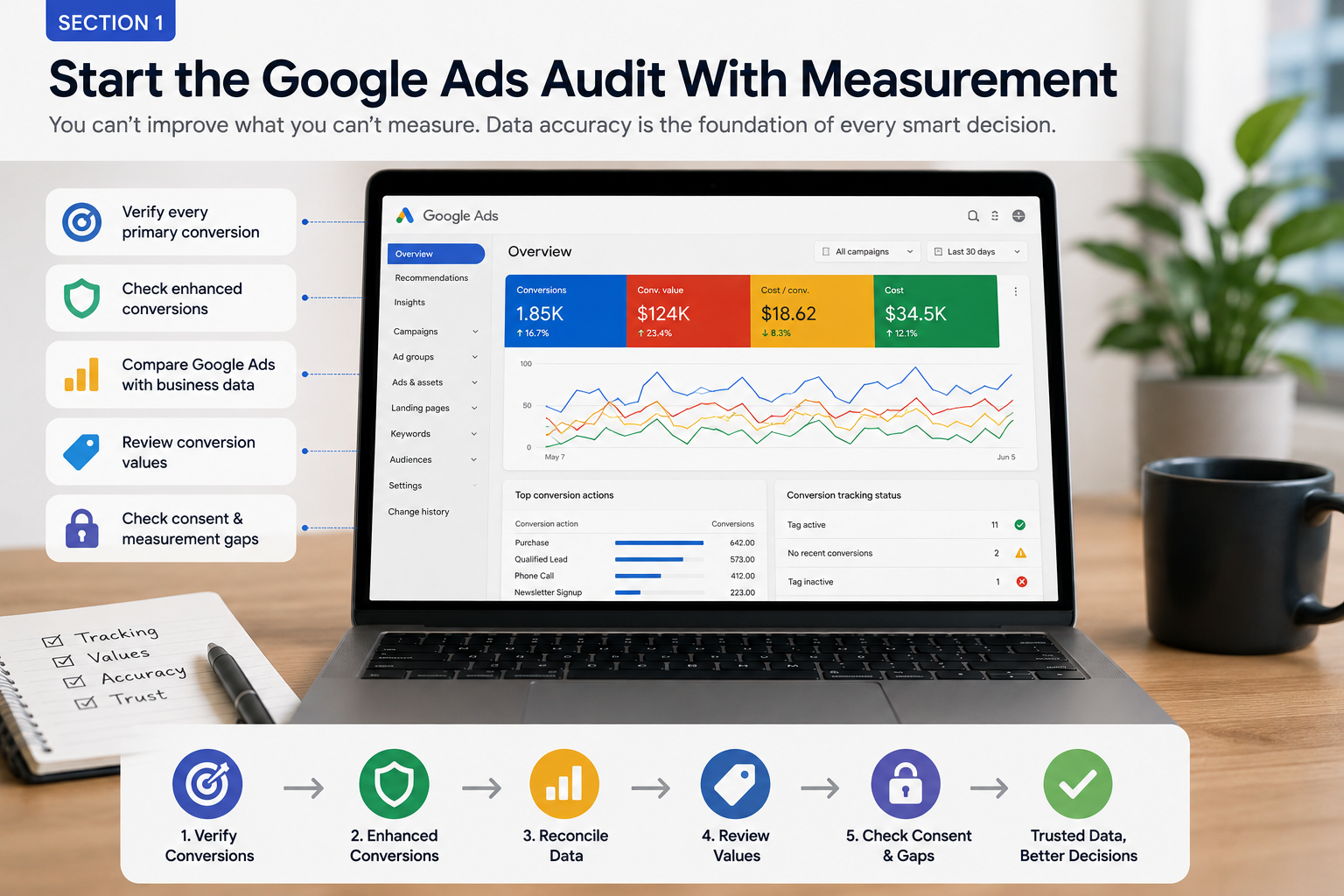
Start the Google Ads Audit With Measurement
Before reviewing keywords or creative, establish whether you trust the numbers. A google ads audit built on unreliable conversion data creates confident but wrong recommendations.
1–5. Measurement Trust Checks
- Verify every primary conversion — purchases, qualified leads, and bookings should not compete with soft actions unless those actions represent real value.
- Check enhanced conversions — review implementation quality, match coverage, and duplicated data sources across tags, Data Manager, and API.
- Compare Google Ads with business data — reconcile with CRM leads, orders, bookings, or revenue before increasing spend.
- Review conversion values — different commercial outcomes should not always send identical signals to bidding.
- Check consent and measurement gaps — consent status can change observable conversion rates and the data available to bidding.
Audit Campaign Economics Before Increasing Budget
Is the account genuinely constrained by budget, or is budget hiding inefficiency?
- 6. Identify campaigns that deserve more spend using marginal CPA, ROAS, profit, lead quality, and conversion delay—not only “Limited by budget.”
- 7. Review budget distribution so profitable campaigns are not starved while weaker ones overspend.
- 8. Audit the bid strategy against the real business objective.
- 9. Review CPA and ROAS targets against break-even economics.
- 10. Check conversion lag before judging recent days of performance.
Review Search Intent, Not Just Keywords
A useful google ads audit follows money down to the query level—especially when comparing paid search quality with Google Search Ads intent control.
- 11. Audit search terms for irrelevant intent and expensive weak-quality queries.
- 12. Rebuild negative keyword logic at campaign, account, and shared-list levels.
- 13. Separate brand economics from non-brand acquisition.
- 14. Review match-type behavior by the queries and conversion quality they produce.
- 15. Audit AI Max deliberately—matching, assets, landing pages, brand and geo controls—before expanding it.
Audit Ads, Assets, and Landing Pages Together
- 16. Review message-to-query alignment across search, ad, and landing page.
- 17. Check RSA coverage—headline variety, benefits, proof, CTAs—without fake “testing.”
- 18. Audit assets: sitelinks, callouts, images, snippets, promotions, and calls.
- 19. Review landing-page friction: mobile speed, forms, trust, and conversion path.
- 20. Connect creative performance with business outcomes, not clicks alone.
If these issues expose broader structural problems, a deeper Google Ads audit should come before routine optimization—especially when account infrastructure is fragmented or teams rent google ads account setups without clear ownership of tracking.
Inspect Performance Max and Operational Risk
- 21. Review Performance Max search terms instead of treating PMax as a black box.
- 22. Check PMax brand, search controls, audience signals, URL expansion, and asset-group logic.
- 23. Audit asset groups by coherent business theme.
- 24. Investigate historical tracking failures before adding budget—often best handled through a structured Google Ads tune-up.
- 25. Create a scale decision: Scale, Fix first, Test, or Stop—not just an audit report.
That final decision is what separates a checklist from an operational google ads audit—the standard a strong google ads agency dubai or Adwords agency uses before increasing spend.
Final Thoughts
The most dangerous time to discover an account problem is after doubling the budget. A google ads audit checklist 2026 should answer one question first: if we increase spend tomorrow, do we trust the system to spend that money intelligently?
Frequently Asked Questions
What should a Google Ads audit checklist cover in 2026?
A complete 2026 checklist should cover measurement trust, campaign economics, search intent, ads and landing pages, Performance Max controls, and operational risk—then end with a clear scale decision.
Should I scale a campaign that is Limited by budget?
Not automatically. Review marginal CPA, ROAS, lead quality, and conversion delay first. Limited by budget only means Google wants more spend—not that the spend is profitable.
Why start a Google Ads audit with conversion tracking?
If primary conversions, values, or enhanced conversions are wrong, Smart Bidding will optimize toward the wrong signal. Scaling then amplifies bad data instead of growth.
When should I fix first instead of scaling?
Fix first when tracking, intent quality, targets, or automation controls are unreliable. Scale only after measurement, economics, and guardrails are trustworthy.