
Real estate marketing in 2026 is more competitive than ever. AI-driven bidding, evolving privacy standards, and increasingly complex buyer journeys have changed how successful campaigns are built. In our comprehensive Real Estate Google Ads Campaign Guide, we walk you through essential google ads management techniques to navigate these shifts and build high-converting strategies.
For developers, brokerages, and property marketers, the goal is no longer generating traffic—it is generating qualified leads that turn into property viewings and sales.
This guide explains how Search Ads and Performance Max can work together to create a scalable real estate lead generation system.
The Real Estate Landscape: Why Traditional Campaigns Are Losing Effectiveness
Many real estate advertisers still operate with campaign structures designed for a much simpler digital environment.
While these methods can still generate leads, they often fail to capture the full value of modern buyer behavior.
Today’s property buyers rarely follow a straight path from search to purchase.
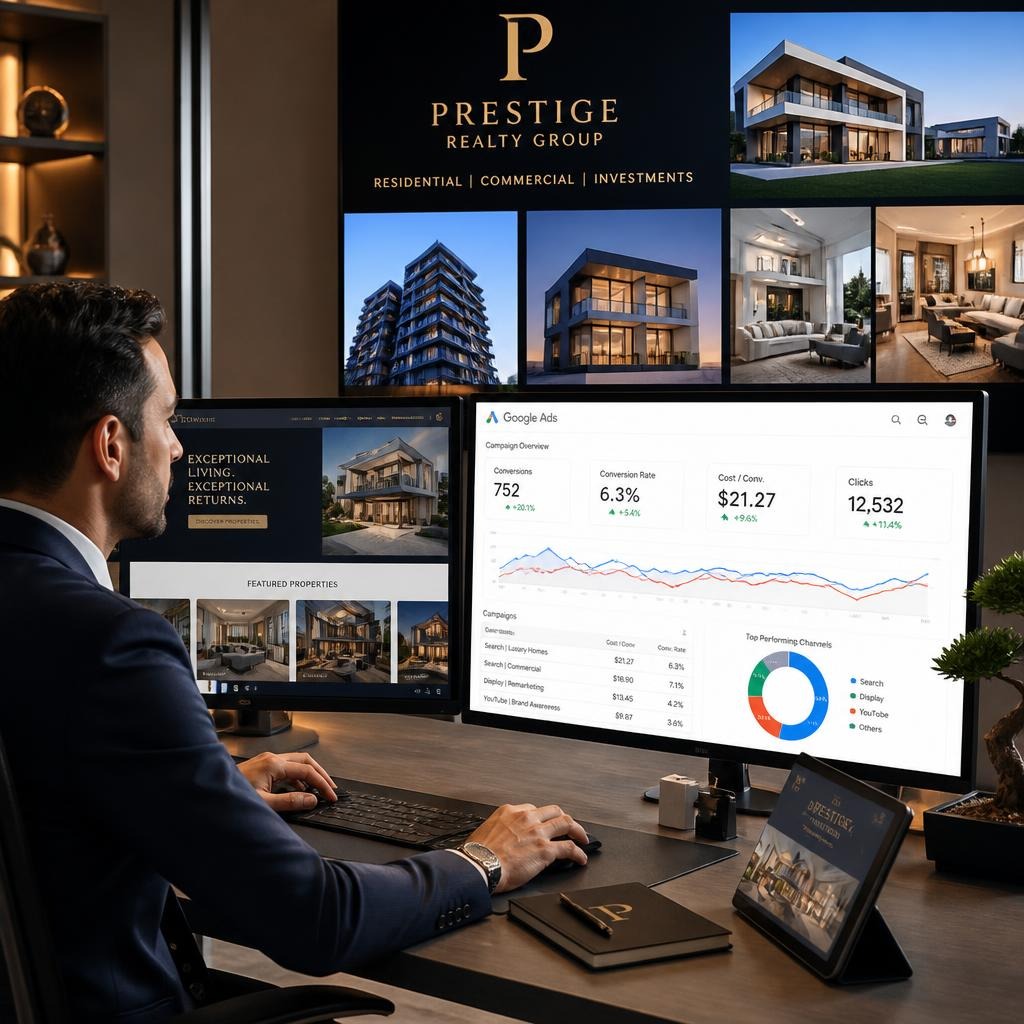
A potential investor may discover a development through YouTube, conduct multiple searches over several weeks, revisit the website through remarketing campaigns, and finally submit an inquiry after comparing multiple properties.
As privacy regulations evolve and third-party cookies become less reliable, Google’s machine learning systems increasingly depend on first-party data and conversion quality signals to optimize campaign performance.
For real estate businesses, the most effective approach in 2026 combines two complementary strategies:
Search Campaigns to capture existing demand.
Performance Max Campaigns to discover and nurture future demand.
Organizations that rely exclusively on one campaign type often miss valuable opportunities throughout the customer journey.
Capturing High-Intent Buyers Through Search Campaigns
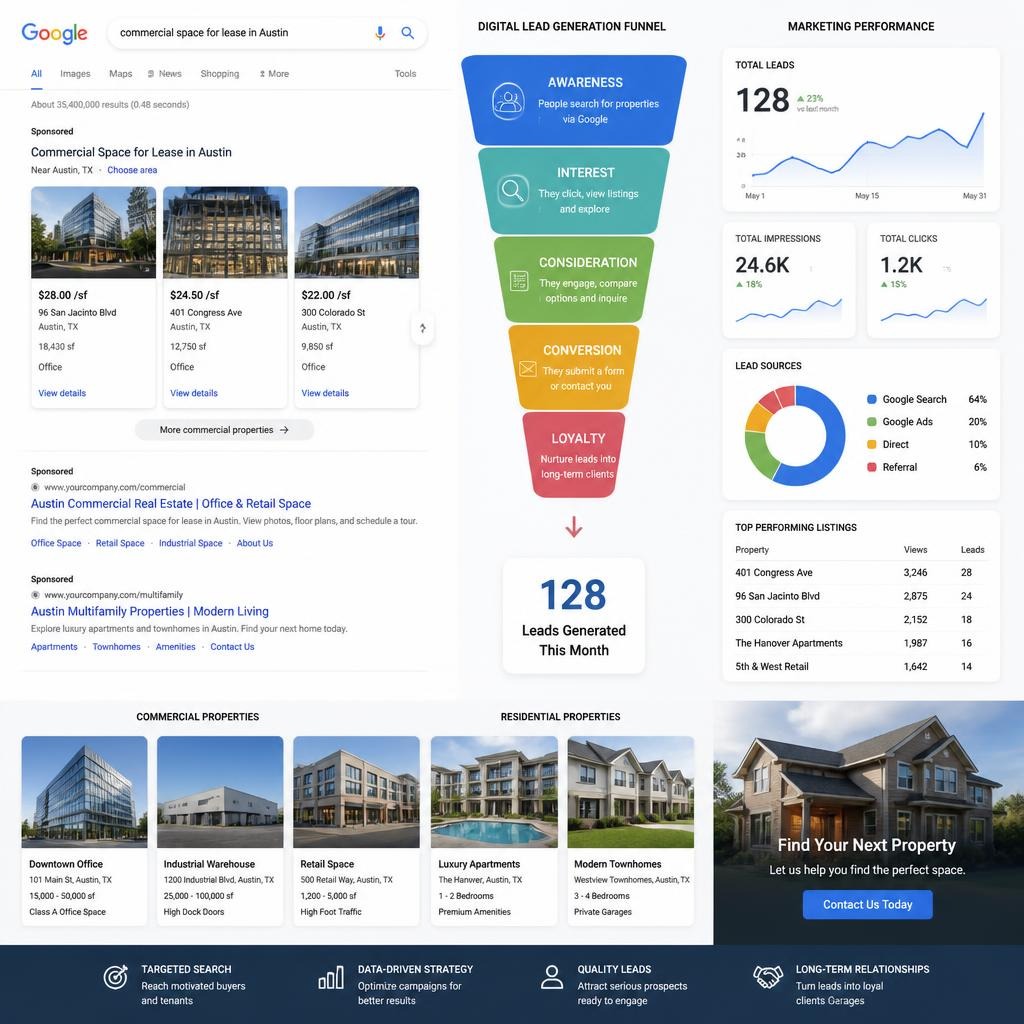
Despite the growth of automation, Search remains one of the most powerful lead generation channels available to real estate businesses.
The reason is simple: Search captures intent.
When users actively search for phrases such as:
- Luxury apartments for sale
- Commercial office space for rent
- Waterfront villas in Dubai
- New residential developments
- Property investment opportunities
they are signaling a specific need and are often much closer to taking action than users reached through awareness campaigns.
Build Campaigns Around Buyer Intent
One common mistake among advertisers is grouping all property-related searches into a single campaign.
A more effective approach is organizing campaigns around distinct buyer intentions.
For example:
Residential Property Searches
- Apartments for sale
- Family homes
- Villas
- Off-plan developments
Commercial Property Searches
- Office space leasing
- Retail properties
- Warehouses
- Investment opportunities
Luxury Property Searches
- Premium residences
- Waterfront developments
- High-net-worth investment properties
This segmentation allows advertisers to create more relevant ad copy, landing pages, and bidding strategies.
Broad Match Has Become Far More Valuable
Many advertisers continue to rely heavily on Exact Match keywords because they believe tighter control automatically produces better results.
However, Google’s machine learning capabilities have improved significantly.
When paired with high-quality conversion tracking and Smart Bidding strategies such as Maximize Conversions or Target CPA, Broad Match often uncovers profitable search queries that would otherwise remain undiscovered.
One trend we’ve consistently observed across competitive property markets is that Broad Match campaigns frequently reveal high-intent investment-related searches that were never included in the original keyword strategy.
The key is not restricting Google’s automation.
The key is feeding it better conversion signals.
Focus on Lead Quality, Not Lead Volume
Lead quality matters more than lead volume. Instead of optimizing only for form submissions or phone calls, advertisers should track deeper conversion actions such as property viewings, qualified investor inquiries, and sales consultations. Importing offline conversions back into Google Ads helps the platform identify leads that are most likely to generate revenue.
Unlocking the Full Potential of Performance Max
While Search campaigns capture demand that already exists, Performance Max helps advertisers generate demand and discover audiences that may not yet be actively searching.
For real estate businesses looking to scale, this represents a significant competitive advantage.
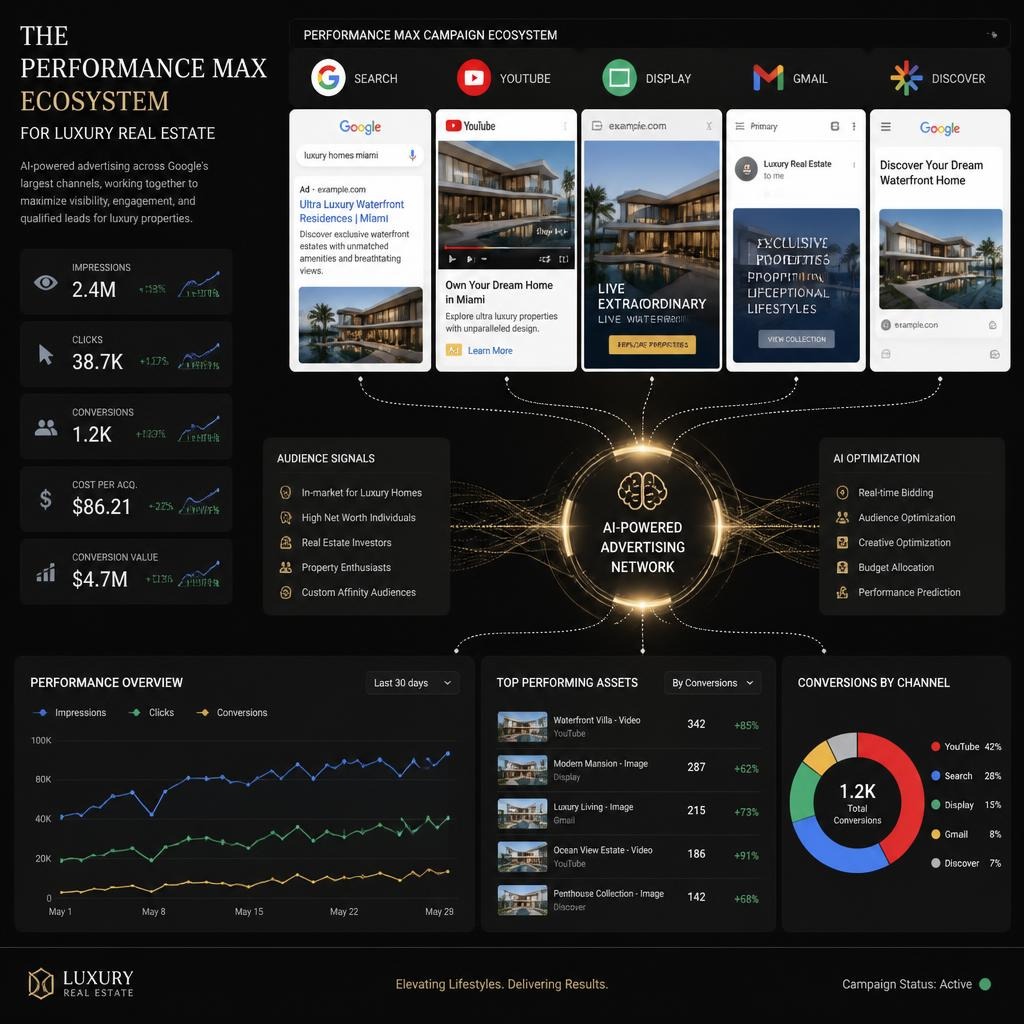
Performance Max provides access to Google’s entire ecosystem through a single campaign structure, including:
- Search, YouTube, Display, Gmail, Discover, and Maps.
This broad reach enables advertisers to engage potential buyers at multiple stages of the customer journey.
However, one of the biggest misconceptions about Performance Max is that it can simply be launched and left alone.
In reality, campaign structure and signal quality have a major influence on performance.
Create Property-Specific Asset Groups
A common mistake among real estate advertisers is placing residential, commercial, and luxury inventory inside the same asset group.
In practice, separating these categories typically provides Google’s algorithm with stronger contextual signals and improves creative relevance.
Consider creating dedicated asset groups for:
- Residential, luxury, commercial, rental, and investment-focused properties.
Each segment attracts different audiences and requires unique messaging.
Property-specific asset groups make it easier for Google’s AI to match creative assets with the most relevant prospects.
Strengthen Audience Signals
Audience Signals help guide Google’s machine learning during the learning phase.
Although they are not strict targeting mechanisms, they provide valuable context regarding the types of users most likely to convert.
Strong Audience Signals often include:
- Strong audience signals typically include CRM lists, previous leads, website visitors, and high-value remarketing audiences.
In our experience, CRM-based audience signals frequently outperform generic website audiences during the early stages of a Performance Max campaign because they provide clearer examples of qualified prospects.
Use Value-Based Optimization
Not all real estate leads carry equal business value.
An inquiry for a luxury waterfront villa may generate substantially more revenue than an inquiry for a standard residential apartment.
Assigning different conversion values to different lead categories helps Google’s bidding algorithms prioritize prospects with greater revenue potential.
This approach often improves profitability without necessarily increasing lead volume.
Maintain Control Over the “Black Box”
Although Performance Max relies heavily on automation, advertisers still retain important optimization controls.
Best practices include:
- Monitoring search themes
- Reviewing asset performance
- Applying brand exclusions
- Managing URL expansion settings
- Excluding irrelevant placements
- Evaluating conversion quality
The highest-performing Performance Max campaigns are rarely fully automated.
Instead, they combine machine learning with ongoing strategic oversight.
By balancing automation with human expertise, real estate businesses can significantly improve both lead quality and return on investment.
Example Scenario: Structuring a Multi-Property Campaign
Imagine a developer promoting luxury villas, residential apartments, and commercial office spaces within the same market.
Instead of placing all inventory into a single Performance Max campaign, separate asset groups can be created for each property category, supported by unique creative assets, audience signals, and landing pages.
This structure helps Google’s AI better understand buyer intent and deliver more relevant messaging to each audience segment. As a result, advertisers often see stronger engagement, higher lead quality, and more efficient budget allocation compared to generalized campaign setups.
The AdMoon Framework: Industry-Specific Campaign Architecture
Real estate advertising differs significantly from e-commerce and local service businesses. Sales cycles are longer, lead values are higher, and buying decisions often involve multiple stakeholders.
For this reason, successful campaigns require a framework built around buyer intent, full-funnel campaign integration, lead quality optimization, and continuous data analysis.
Rather than focusing solely on clicks or form submissions, the objective is to generate qualified opportunities that contribute directly to revenue growth.
Measuring Success: Real Estate PPC Benchmarks That Matter
While Cost Per Lead (CPL) remains an important metric, it should never be viewed in isolation.
Real estate advertisers should also monitor:
- Cost Per Qualified Lead (CPQL)
- Lead-to-Viewing Rate
- Lead-to-Sale Rate
- Customer Acquisition Cost (CAC)
- Return on Ad Spend (ROAS)
A campaign generating fewer but higher-quality leads will often outperform one producing large volumes of low-intent inquiries. Ultimately, success should be measured by revenue impact rather than lead volume alone.
Search Ads vs Performance Max: Which Delivers Better Results?
| Factor | Search Ads | Performance Max |
| Lead Quality | High | Medium to High |
| Buyer Intent | Immediate | Mixed |
| Audience Discovery | Limited | Strong |
| Keyword Control | Full | Limited |
| Scalability | Moderate | High |
| Learning Period | Shorter | Longer |
| Best Use Case | Bottom-Funnel Lead Generation | Full-Funnel Growth |
| Creative Flexibility | Moderate | High |
| Automation Level | Medium | High |
For most real estate businesses, the question is not whether to choose Search or Performance Max.
The strongest results usually come from combining both campaign types within a unified acquisition strategy.
Search captures users actively looking for properties.
Performance Max helps identify future buyers before competitors reach them.
When used together, they create a balanced system capable of generating both immediate and long-term growth.
Frequently Asked Questions
Are Google Ads worth it for real estate agents?
Yes. Google Ads remains one of the most effective channels for reaching high-intent buyers, investors, and property seekers. When supported by accurate conversion tracking and strong campaign structure, it can generate highly qualified leads at scale.
Should real estate businesses use Performance Max?
For most businesses, yes. Performance Max complements Search campaigns by expanding reach across Google’s advertising ecosystem and identifying new audience opportunities.
Search Ads vs Performance Max for Real Estate: Which Performs Better?
Search campaigns typically generate higher-intent leads because users are actively searching for properties. Performance Max excels at audience discovery and full-funnel growth. Most real estate businesses achieve the strongest results when using both together.
Conclusion
The real estate advertising landscape is becoming increasingly competitive, and businesses that rely on outdated campaign structures risk falling behind.
Success in 2026 is no longer about generating clicks.
It is about generating qualified opportunities.
By combining high-intent Search campaigns with strategically structured Performance Max campaigns, real estate businesses can build a scalable acquisition system that supports both immediate lead generation and long-term growth.
The organizations that succeed over the next few years will be those that effectively combine Google’s automation capabilities with strong data, clear audience segmentation, and continuous Google Ads Optimization. In a market where every lead can represent a significant revenue opportunity, strategic execution matters more than ever.
In a market where every lead can represent a significant revenue opportunity, strategic execution matters more than ever.
Ready to Generate More Qualified Real Estate Leads?
Not sure whether Search Ads, Performance Max, or a hybrid strategy is the right fit for your business?
Book a free consultation with the AdMoon team.
We’ll review your current advertising strategy, identify growth opportunities, analyze potential inefficiencies, and provide actionable recommendations tailored to your market, property portfolio, and business goals.
Whether you’re promoting residential developments, commercial properties, luxury projects, or investment opportunities, our team can help you build a Google Ads strategy designed for sustainable growth and measurable ROI.
Book Your Free Consultation Today and Discover What’s Possible with a Smarter Real Estate Advertising Strategy.