
Google Ads is a powerful platform — and, if you have spent any real time inside it, an overwhelming one too. The reporting runs deep, the settings multiply quickly, and the results tend to go to those who already know exactly what they are doing. If you have been testing campaigns, searching for the Best Pricing Strategies, and adjusting budgets month after month, watching the spend go out, and still not quite seeing the returns you had in mind, you are not alone. That experience is far more common than most people admit.
Running a successful Google Ads Agency Account takes real experience, consistent strategy, and the kind of time most business owners simply cannot carve out while also running everything else. That is exactly where the right agency changes things. But beyond who manages your account, there is something equally important to get right — how you pay for those services. Choosing from the best pricing strategies is not just a billing decision. It directly shapes your ROI, your ability to scale, and what you actually receive in return for your investment.
What Pricing Means for a Google Ads Agency Account
When you bring an agency on board, the pricing model they use says more than most people realize. It is not just a number on a monthly invoice — it reflects how they structure their work, where they focus their attention, and whether their incentives actually line up with yours or quietly run in a different direction.
Every Google Ads agency account is built differently. A local service business running a single campaign has completely different needs from a growing e-commerce brand juggling dozens of product groups across multiple markets. Agencies use different pricing structures precisely because one model never fits everyone cleanly. The goal is not simply to pay less — it is to find a structure that genuinely supports the growth you are trying to achieve. The best pricing strategies create a real balance: you feel confident in what you are investing, and the agency has enough breathing room to do their best work rather than their fastest work. If you are approaching a Google Ads agency for the first time, understanding these models before you commit to anything is one of the most practical steps you can take.
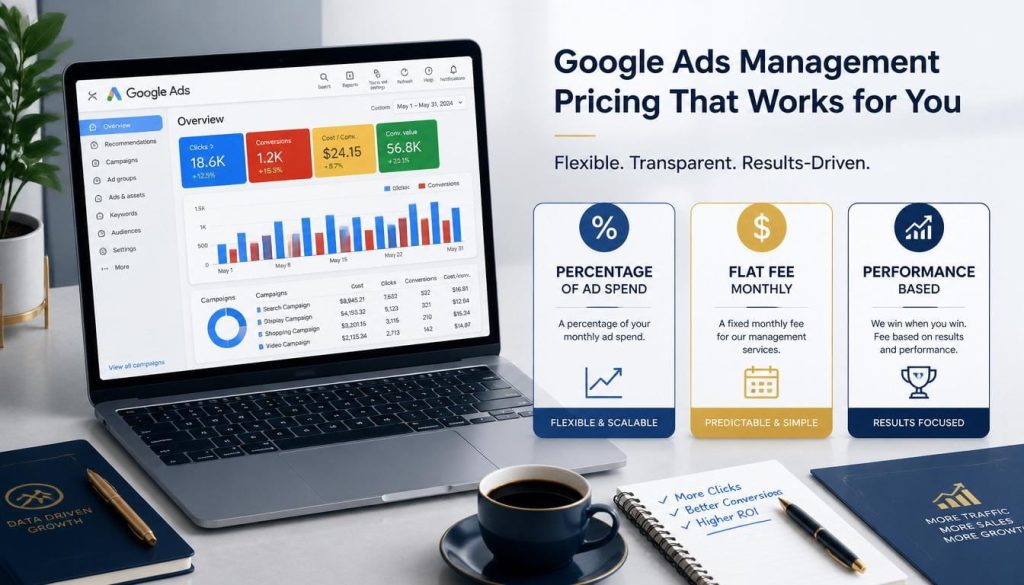
Strategy 1: Percentage of Ad Spend
The percentage of ad spend model is one of the most widely recognized approaches for managing a Google Ads agency account, and it is not hard to understand why it became so popular. The agency charges a fixed percentage of whatever you spend on ads each month. If your budget sits at 0,000 and the agreed rate is 15%, you pay 500 in management fees on top of your actual ad spend.
On the surface, this feels logical. As your spend increases, your campaigns typically grow more complex — more audiences to manage, more creative variations to test, more signals to interpret. The idea that cost should scale alongside the work makes reasonable sense.
It also offers real flexibility. During a slower period, when you pull your budget back, your management fee comes down with it. For businesses with seasonal revenue patterns, that kind of built-in adaptability is genuinely useful — not just a selling point on a pitch deck.
The tension worth acknowledging, though, is that at higher budget levels, the fee can become quite significant even when the actual day-to-day workload has not grown at the same rate. It is worth raising that conversation openly with any agency before you sign. For a practical breakdown of how Google Ads costs work from the ground up, the HubSpot guide to Google Ads best practices is a solid reference. For businesses actively scaling, this remains one of the best pricing strategies available.
Strategy 2: Flat Monthly Fee Model
The flat monthly fee model is exactly what it sounds like: one fixed amount every month, regardless of what happens with your ad spend. Your budget can double or pull back — your management fee stays the same either way.
For most business owners, this brings genuine relief. No unexpected numbers at the end of the month, no recalculating the invoice whenever a campaign budget changes, no friction when you want to test a higher spend for a short period. You know your cost, you plan around it, and you move forward without that variable hanging over your decisions.
There is also a quiet but meaningful alignment built into this structure. Because the agency earns the same fee regardless of how much you spend on ads, they have no financial reason to push you toward a higher budget. Their focus stays where it should — on making your campaigns perform better, not on growing your spend.
The nuance is in how that flat fee gets set in the first place. A Google Ads agency account with multiple campaigns, layered audience segments, and frequent creative refreshes demands a lot more ongoing attention than a single straightforward setup. A good agency scopes the work honestly and prices accordingly — not with a blanket number they apply to everyone. This model works best for businesses that want clarity, predictability, and a steady partnership they can plan around. See how Admoon structures its Google Ads management if this approach sounds right for you.
Strategy 3: Performance Based Pricing
Performance-based pricing is, on paper, the most appealing of the three models. Rather than paying for time spent or a portion of your ad budget, you pay based on what actually happens — leads generated, conversions completed, or revenue produced directly from your campaigns.
The appeal is straightforward. If the agency does not deliver, you do not pay much — or in some arrangements, you do not pay at all beyond a small base. In practice, most performance-based agreements work as a hybrid: a modest retainer covers the agency’s core costs, with bonuses added when agreed targets are hit. This keeps both parties genuinely invested in the same outcome.
There is, however, one requirement that cannot be skipped: clean, reliable tracking. Without accurate conversion data, it is genuinely impossible to fairly attribute results to the ads specifically. And advertising results never live in a vacuum — your landing page, your offer, your pricing, and the broader market all influence outcomes in ways the agency cannot fully control.
Not every Google Ads agency account is the right fit for this model because of that. It works best when your tracking setup is solid, your offer is proven, and there is real trust established on both sides. When those conditions exist, it can be one of the best pricing strategies for growth-driven businesses. See how Admoon approaches performance-based campaigns for a practical look at how it works.

Choosing the Right Strategy for Your Account
There is no universal answer — the right pricing model depends entirely on where your business is today and what you need most from the relationship you are building.
If predictability matters most, a flat monthly fee gives you that. If your budgets shift regularly and you want management costs to move with them, a percentage model makes more sense. And if results are the only thing on your mind — and your tracking is clean enough to measure them properly — performance-based pricing puts your investment directly behind what counts.
One thing worth remembering: any pricing conversation with a potential agency should feel like a real dialogue, not a take-it-or-leave-it offer. Good agencies are willing to explain their model clearly, walk you through what it covers, and adjust when the fit is not quite right.
The best pricing strategies are honest ones — fair to you, sustainable for the agency, and pointed toward the same goal.
Conclusion
Managing a Google Ads agency account well is never just about the ads. It is about the decisions that sit underneath them — the strategy, the data, the creative direction, and the pricing model that shapes how the whole relationship actually works.
The best pricing strategies are not about finding the cheapest option. They are about finding the right fit — a structure where you know exactly what you are paying for, the agency knows precisely what is expected of them, and both sides are genuinely working toward the same outcome.
When that alignment is in place, things move differently. Decisions come faster, campaigns get the space they need to grow, and the results you have been working toward start to feel a lot more within reach. Choose thoughtfully — the pricing model you pick is not just a cost. It is part of the foundation your growth is built on.