
A traveler doesn’t shop for a hotel like they’d shop for a laptop. It’s a late Tuesday night, a search bar, and a decision made in minutes. That moment is exactly where Google Ads for Hotels and Resorts does its heaviest lifting.
Most hotels still rely on OTAs — and most feel it in margin, in dependency, and in zero ownership of the guest relationship. Google Ads for businesses puts your property in front of a traveler the instant they’re deciding, not after they’ve already committed to someone else’s platform.This same precision exists in Google Ads for educational institutions lead generation.

Why Hotels Rely on Google Ads for Businesses
Here’s the core problem with OTA reliance: you don’t own the customer. They book through Booking.com or Expedia, the platform collects the data, charges 15–20% commission, and you get a reservation with no email address attached. Run that model long enough and you’ve essentially paid to build someone else’s business.Similar lessons can be seen in Google Ads for educational institutions lead generation.
Google Ads for businesses flips that. When a traveler searches “boutique hotel near Dubai Marina” or “family resort Abu Dhabi weekend,” your property can appear above the organic results — before the OTAs, before the aggregators. And because the click goes to your own booking page, you own the conversion and the guest relationship, just like in Google Ads for educational institutions lead generation.
38% drop in cost per booking after shifting budget from broad awareness to intent-based search campaigns.
Observed across hospitality accounts after restructuring from brand awareness to high-intent search. Results vary by market and budget.
Building Campaigns That Actually Move Bookings
The most common version of hotel Google Ads: one campaign, broad match keywords, a slow landing page, no audience segments. It is spent. It doesn’t convert. And the team concludes Google Ads for businesses doesn’t work for hospitality. It does — it just requires structure, exactly like Google Ads for educational institutions lead generation.
Start With Search Intent, Not Budget
The backbone of any hotel campaign is search intent. Not demographics. Not interested. What is someone typing when they’re ready to book?This principle mirrors Google Ads for educational institutions lead generation.
There are three tiers:
High intent: “book hotel Marina Bay weekend” — campaign-ready
Mid-intent: “best resorts for family vacation Dubai” — needs remarketing, not conversion push
Low intent: “things to do in Dubai” — content territory, not ad territory
Most accounts mix all three and bid equally on them. Separating them is one of the most impactful structural changes you can make inside Google Ads for businesses campaigns, and it’s equally true in Google Ads for educational institutions lead generation.
This is also where Google Search Ads become the most valuable tool in the stack. Unlike display or social, search puts you in front of a traveler who has already formed the intent — you’re not creating demand, you’re capturing it.That’s the same conversion model as Google Ads for educational institutions lead generation.
Segment Your Audiences Before You Segment Your Budget
A couple looking for a honeymoon escape and a family trying to manage three kids at a pool have completely different search behaviors, landing page needs, and price sensitivities. Running both into the same campaign is how you get mediocre performance across all of it. Audience behavior works similarly in Google Ads for educational institutions lead generation.
We build separate campaigns or ad groups for:
Couples and honeymoon travelers
Families with specific amenity searches
Corporate and business travel
Last-minute bookers (different bid strategy, different messaging)
Each segment gets its own landing experience. The couple sees “private pool suites — limited availability.” The family sees “kids stay free, splash park included.” Same property. Completely different reason to book.
From Click to Confirmation: Where Most Hotels Lose the Booking Optimizing Google Ads for Hotels and Resorts
A well-structured Google Ads for businesses campaign can send the right traveler to your website and still lose the booking. Not because of the ad. Because of what comes after.
One resort we audited had a landing page load time of 6.2 seconds. Their ads were solid. Their targeting was on point. Their cost per click was competitive. Their conversion rate was 0.8% — a fraction of what it should have been. After page speed optimization and above-the-fold redesign, conversions went up 52%. These Google Ads optimization principles mirror the strategies used in Google Ads for educational institutions lead generation.
The funnel is simple: intent → click → landing page → booking. Most hotels have a problem at step three. Fix the experience before increasing ad spend. The same funnel logic exists in Google Ads for educational institutions lead generation.
52% increase in bookings after landing page optimization — with no changes to ad campaigns.
Speed and above-the-fold UX were the primary factors. Mobile accounted for over 60% of the traffic in this case.
What Google Ads for Educational Institutions Taught Us About Hotels
Some of our strongest hospitality campaign improvements came from Google Ads for educational institutions lead generation work. The decision psychology is nearly identical: a student choosing a university and a traveler choosing a resort are both making an emotional, time-pressured decision against multiple alternatives.
The urgency frameworks we refined for Google Ads for educational institutions lead generation — specific deadlines, social proof, scarcity signals — translated directly into hotel ad copy. “Only 3 suites available this weekend” works for the same reason “Applications close Friday” works. Specific, and it forces a decision.
That’s the value of cross-vertical thinking. Look at industry solutions across sectors and you start finding frameworks that outperform anything built in isolation.
Tourism Campaigns and the Ecosystem Around Your Property
Here’s something most hotel ad managers miss: the traveler booking your resort isn’t just searching for a room. They’re planning an experience.That planning behavior is also central in Google Ads for educational institutions lead generation.
That’s why aligning hotel campaigns with broader Google Ads Dubai Tourism Campaigns strategy can unlock a segment of travelers who aren’t yet in booking mode but are in planning mode — and who can be moved into your funnel with the right remarketing setup.
When you map your Google Ads for businesses campaigns against destination-level search behavior, you start intercepting travelers earlier. Someone searching “Dubai summer 2025 activities” today might book a room next week. If your remarketing pixel saw them, you can be the property that’s already in front of them when they get there.
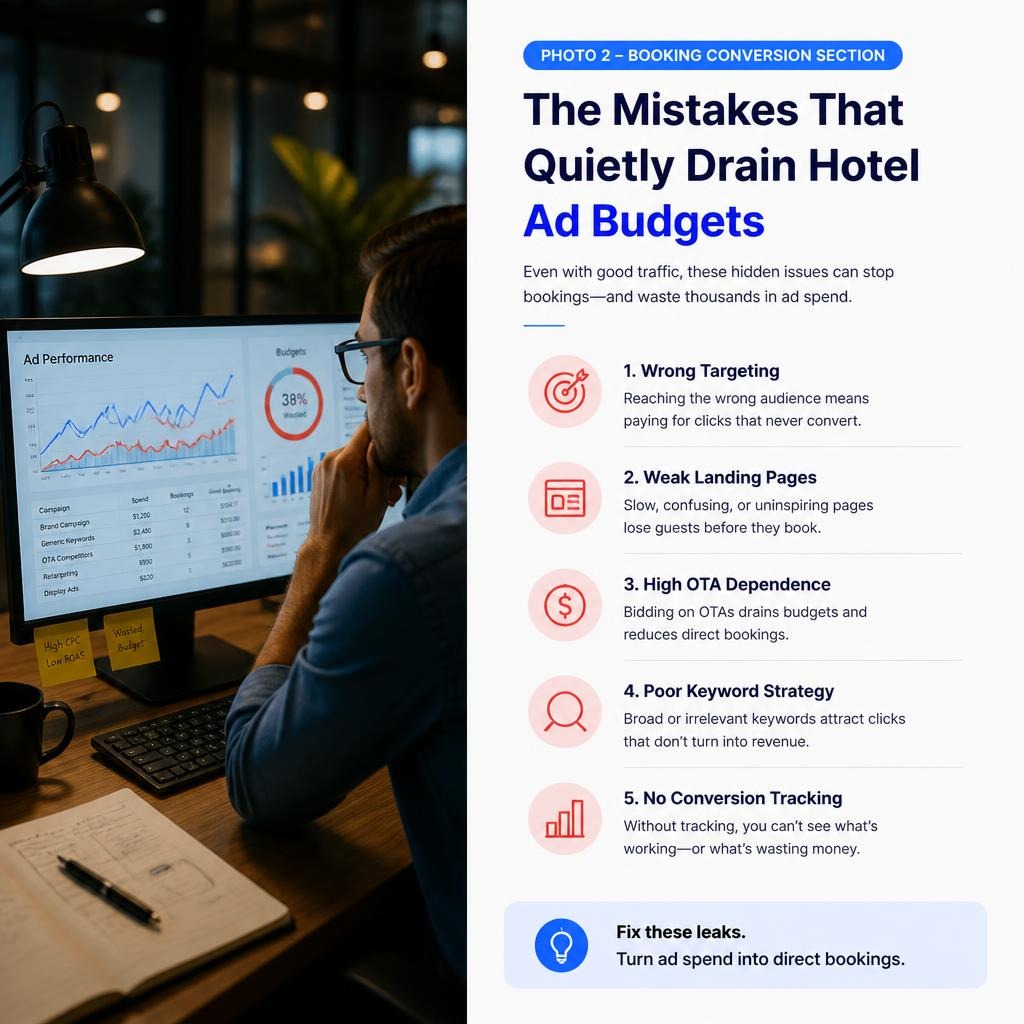
The Mistakes That Quietly Drain Hotel Ad Budgets
In most accounts we audit, waste isn’t dramatic — it’s quiet. The same five missteps, compounding silently across Google Ads for businesses campaigns until 30–40% of budget is gone: These mistakes are also common in Google Ads for educational institutions lead generation.
Broad match keywords without negative keyword lists
No brand vs. non-brand campaign separation — branded search ROI gets muddied with generic performance
Mobile booking page is an afterthought — 60%+ of hotel searches happen on mobile, and a poor experience kills conversions
Remarketing turned off or underbudgeted — returning visitors convert at 2–4x the rate of new ones
Bid strategy set and never revisited — what worked in February doesn’t work in July
Frequently Asked Questions
What is the most effective Google Ads campaign type for hotels?
Search campaigns targeting high-intent keywords. Performance Max can supplement reach, but search remains the core booking driver.
Can Google Ads help fill off-season rooms?
Yes. Lower CPCs in slow periods make it ideal for off-peak demand. Seasonal bid adjustments and geo-targeting nearby metros are the go-to tactics.
What’s the biggest mistake hotels make with Google Ads?
Broad match keywords without a negative keyword list. The budget goes to irrelevant searches, CPA inflates, and real bookings don’t follow.
Final Thought: Control Is the Real Goal
Hotels don’t need more traffic. They need the right traffic at the right moment — traffic they own the relationship with after the booking, not traffic rented from an OTA at 20% commission.This ownership principle also applies in Google Ads for educational institutions lead generation.
Google Ads for businesses in hospitality is fundamentally about that control: who sees you, when they see you, what they land on, and what they pay. Meet the intent where it forms, and make the decision to book as easy as possible. That’s the whole game.
For account-level data and campaign setup, Google Ads is where it starts. The strategy behind it is where we come in.
Ready to Turn Your Ad Spend Into Direct Bookings?
Most hotel accounts we audit are wasting at least 30–40% of their Google Ads budget on the wrong keywords, the wrong audiences, or both. A structured campaign built around booking intent changes that — just like it does in Google Ads for educational institutions lead generation.
→ Book a free Google Ads audit at Admoon Google Ads agency and see exactly where your budget is going.