
Introduction
Successful Google Ads management is no longer about manually adjusting bids and writing endless ad variations. Today, campaign performance increasingly depends on how effectively advertisers use Google’s AI-powered systems. Among the most important automation technologies are AI Max and Performance Max (PMax). While both rely on machine learning, they serve different purposes within a modern strategy managed by a professional Google Ads agency.
AI Max vs Performance Max: Key Differences
| Feature | AI Max | Performance Max |
| Primary Focus | Search intent optimization | Cross-channel automation |
| Placements | Google Search only | Search, YouTube, Display, Gmail, Discover, Maps |
| Ad Types | Dynamic text ads | Image, video, text, Shopping ads |
| Human Control | High campaign control | Highly automated |
| Best For | Lead generation & Search campaigns | E-commerce & broad prospecting |
| Keyword Visibility | Strong visibility | Limited transparency |
The core difference comes down to control and inventory.
AI Max enhances traditional Search campaigns while preserving campaign structure and keyword-level optimization. Performance Max operates more like a “black box,” automatically distributing ads across multiple Google properties with minimal manual control.
The Role of AI Max and Performance Max in Google Ads Management
Modern Google Ads management is no longer about manually adjusting every bid, keyword, and ad variation. As Google’s automation capabilities continue to evolve, the role of campaign managers has shifted from execution to strategy.
AI Max and Performance Max are powerful tools for AdWords optimization, but they are not replacements for experienced advertisers. While these systems can automate targeting, bidding, ad creation, and audience expansion, they still require strategic oversight to align campaign performance with business objectives.
Successful Google Ads management depends on making the right decisions about account structure, budget allocation, audience targeting, creative strategy, and performance measurement. AI can execute many tasks faster than humans, but it cannot fully understand business priorities, profit margins, sales cycles, or customer lifetime value.
Rather than replacing campaign managers, AI Max and Performance Max allow marketers to spend less time on repetitive optimization and more time on high-level decision-making. The advertisers who achieve the best results are those who combine Google’s automation with a clear strategic framework and ongoing performance analysis.
How Professional Google Ads Managers Use Both Systems
Professional Google Ads managers rarely view AI Max and Performance Max as competing solutions. Instead, they use each platform where it delivers the greatest value.
For example, AI Max is often deployed within Search campaigns that target high-intent users actively looking for products or services. Because it operates within the Search Network and preserves valuable keyword insights, it is particularly effective for lead generation, local services, and B2B campaigns where search intent plays a critical role.
Performance Max, on the other hand, is commonly used for broader customer acquisition strategies. Its ability to serve ads across YouTube, Display, Discover, Gmail, Maps, and Shopping inventory makes it an effective solution for e-commerce growth, remarketing, and top-of-funnel prospecting.
A typical account structure might look like this:
- High-intent Search campaigns → AI Max
- Lead generation campaigns → AI Max
- Shopping campaigns → Performance Max
- Remarketing campaigns → Performance Max
- Cross-channel customer acquisition → Performance Max
By assigning each system a specific role, advertisers can avoid overlap, improve budget efficiency, and create a more scalable account structure. This strategic combination forms the foundation of what many advanced agencies now refer to as the Power Pack approach.
How AI Max Works in Google Ads
AI Max acts as an intelligent optimization layer inside Search campaigns. Instead of replacing your Search structure, it improves performance using Google’s generative AI systems.
Its optimization framework relies on three main components:
1. Search Intent Matching
AI Max expands keyword targeting by analyzing user intent rather than relying only on exact keyword variations. This helps advertisers capture additional high-intent searches without aggressively broadening campaigns.
2. Dynamic Text Customization
Google dynamically generates headlines and descriptions based on the user’s query and landing page content. This improves ad relevance and increases the likelihood of engagement.
3. Final URL Expansion
AI Max can automatically direct users to the most relevant page on your website instead of sending all traffic to a single static landing page.
For service-based businesses and lead generation campaigns, this creates a strong balance between automation and campaign control.
How Performance Max Works
Performance Max is designed for advertisers who want maximum reach across Google’s advertising ecosystem.
Instead of focusing only on Search, PMax distributes ads across:
- YouTube
- Display
- Gmail
- Discover
- Google Maps
- Shopping inventory
Advertisers upload creative assets such as:
- Headlines
- Descriptions
- Images
- Logos
- Videos
- Product feeds
Google’s AI then combines these assets dynamically depending on user behavior and platform placement.
Performance Max works especially well for:
- E-commerce stores
- Retail brands
- Large product catalogs
- Visual remarketing campaigns
- Broad customer acquisition
However, the tradeoff is reduced transparency and less granular keyword control.
Can AI Max Improve Quality Score?
One of the biggest advantages of AI Max is its ability to improve key Quality Score signals inside Search campaigns.
Better Ad Relevance
Traditional Broad Match campaigns often struggle with poor ad relevance because user queries vary significantly. AI Max solves this problem by dynamically generating highly relevant ad copy based on the exact search query.
This stronger alignment between keyword, query, and ad text can significantly improve Quality Score.
Improved Landing Page Experience
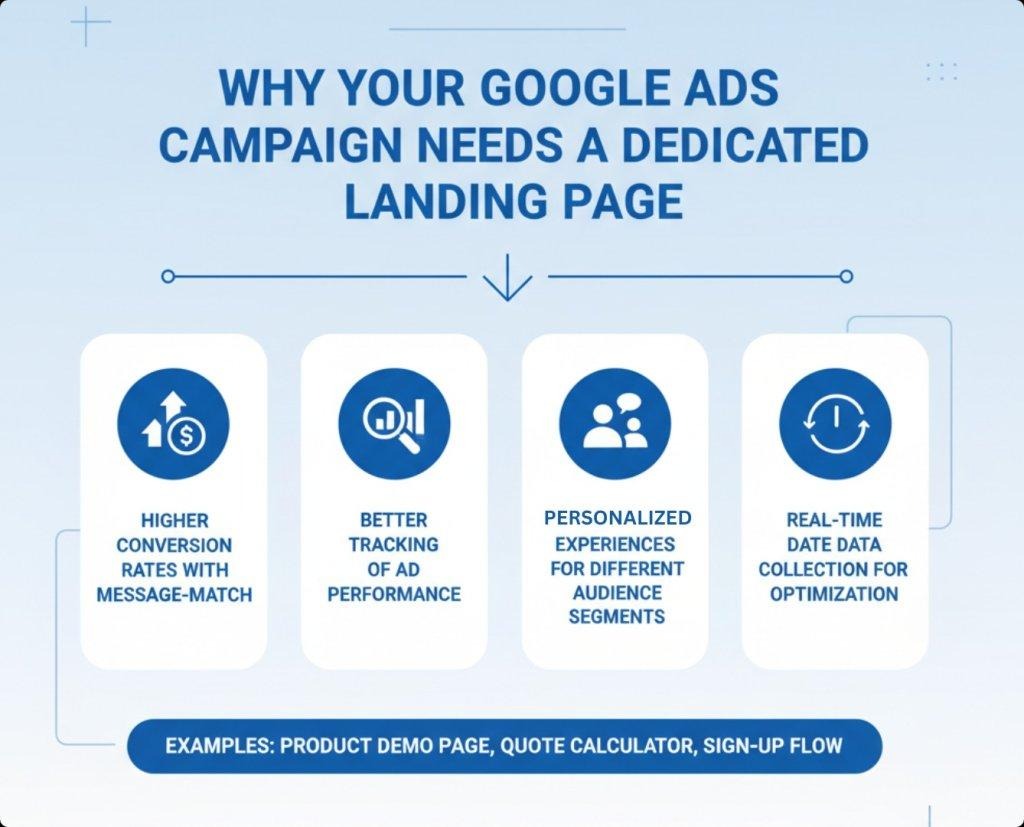
AI Max’s Final URL Expansion sends users to the most relevant page on your website. When landing pages closely match search intent, bounce rates decrease and engagement signals improve.
Stronger Keyword Visibility
Unlike Performance Max, AI Max still preserves valuable keyword-level data. This gives advertisers better visibility into performance trends and optimization opportunities.
For advertisers trying to reduce CPCs and improve Search efficiency, AI Max can become a powerful optimization tool.
When to Use AI Max vs Performance Max
Choosing the right system depends entirely on your business model and campaign goals.
Use AI Max If:
- You run lead generation campaigns
- You rely heavily on Search traffic
- You need stronger keyword visibility
- You manage service-based businesses
- You want more control over optimization
Use Performance Max If:
- You operate an e-commerce store
- You have a strong product feed
- You want cross-channel visibility
- You rely on visual creatives and remarketing
- You want to scale Shopping campaigns
The Power Pack Strategy: Using Both Together
Top-performing agencies increasingly combine AI Max and Performance Max into a dual-engine framework sometimes called the “Power Pack” strategy.
The idea is simple:
- AI Max captures high-intent Search traffic
- Performance Max handles broad visual prospecting
This prevents both systems from competing against each other while maximizing total account coverage.
How to Prevent Cannibalization
One of the most effective strategies is adding your high-converting Search keywords as negative keywords inside Performance Max campaigns.
This forces:
- AI Max → to dominate bottom-funnel Search intent
- PMax → to focus on discovery, YouTube, Display, and retargeting
The result is cleaner traffic segmentation and more efficient budget allocation.
Brand Safety Checklist for AI Campaigns
Automation can improve efficiency, but it still requires oversight.
To maintain account quality and protect brand safety:
- Exclude branded terms where necessary
- Block low-converting URLs from Final URL Expansion
- Exclude “About Us” and policy pages
- Monitor Search Partner traffic regularly
- Set clear creative guidelines for AI-generated copy
- Review placement quality inside Display campaigns
Without proper supervision, automated systems can waste budget or generate low-quality traffic.
Case Study: Combining AI Max and PMax
A premium skincare brand recently restructured its Google Ads account using the Power Pack strategy.
Initial Problems
- Rising CPCs on Search campaigns
- Poor Quality Scores
- Weak YouTube and Display performance
Strategy
The company:
- Activated AI Max across service-focused Search campaigns
- Launched a separate Performance Max campaign for e-commerce products
- Added service keywords as negatives inside PMax
Results After 3 Months
| KPI | Before | After |
| Average Quality Score | 4/10 | 8/10 |
| Average CPC | $1.80 | $1.10 |
| Conversion Rate | 1.4% | 2.5% |
| ROAS | 210% | 365% |
The company succeeded because each AI system was assigned a specific role instead of overlapping responsibilities.
FAQ
What is the difference between AI Max and Performance Max?
What is the difference between AI Max and Performance Max?
What is the difference between AI Max and Performance Max?
AI Max improves Search campaigns through AI-driven optimization, while Performance Max distributes ads across all Google channels using full automation.
Can AI Max improve Quality Score?
Yes. AI Max improves ad relevance, landing page alignment, and query matching, which can positively impact Quality Score.
Should I use AI Max and PMax together?
In many cases, yes. Combining both systems allows advertisers to separate high-intent Search traffic from broader cross-channel prospecting.
Is Performance Max good for lead generation?
It can work for lead generation, but it generally performs better for e-commerce and visual prospecting campaigns.
Final Verdict
AI Max and Performance Max are not competing systems they are complementary tools built for different advertising objectives.
Performance Max excels at large-scale visibility and automated prospecting across Google’s ecosystem. AI Max excels at improving Search intent targeting, ad relevance, and campaign efficiency inside the Search Network.
The most effective advertisers in 2026 will not rely on a single AI engine. They will build structured frameworks that combine both systems strategically while maintaining strong oversight, keyword control, and brand safety.
If implemented correctly, AI Max and Performance Max together can create a highly scalable Google Ads growth engine with lower CPCs, stronger conversion rates, and improved long-term profitability.
Ready to Scale Your Google Ads Performance?
AI Max and Performance Max can dramatically improve campaign performance, but only when they are implemented within the right account structure. Our Google Ads management team helps businesses combine automation with strategic oversight to maximize ROAS, reduce wasted spend, and scale profitable growth. Contact us today for a free account review and discover how a modern AI-powered Google Ads strategy can transform your results.