
The Shift From Keywords to Intent
For years, high-level PPC management was built around precision. Advertisers carefully separated keywords into Exact, Phrase, and Broad Match structures while aggressively controlling search queries through negatives and SKAG-style campaign setups. However, recent Google Ads Match Types AI updates have fundamentally shifted this approach, moving us away from manual syntax control toward intent-based automation..
That model no longer reflects how Google Search works.
After multiple AI-driven updates to Google’s matching systems, keyword match types have evolved from literal syntax controls into intent signals. Today, a professional Google Ads agency helps brands navigate these shifts, as Google’s machine learning systems now analyze the meaning behind a query rather than simply matching words.
This shift has fundamentally changed modern google ads management.
Instead of asking:
“Did the user type my exact keyword?”
Google now asks:
“Does this search represent the same intent?”
Understanding this evolution is critical if you want to scale Search campaigns efficiently in 2026.
What Changed in Google Ads Match Types?
The biggest impact of recent Google Ads match types AI updates is that all match types now rely heavily on semantic interpretation.
In practice, this means:
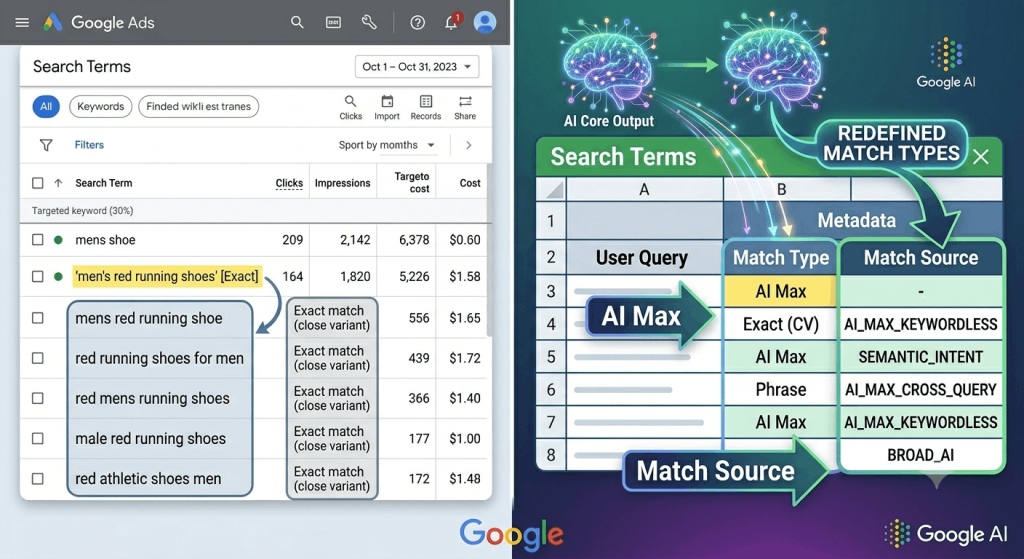
- Exact Match is no longer truly exact
- Phrase Match allows much broader variations
- Broad Match has become AI-assisted targeting
- Search campaigns increasingly depend on Smart Bidding and conversion data
Google’s system now evaluates:
- user intent
- previous search behavior
- landing page relevance
- ad group context
- semantic relationships between words
As a result, older account structures built around isolated match types are becoming less effective.
Exact Match Is Now Intent Match
Historically, Exact Match only triggered ads when a user typed a nearly identical query.
Today, Google groups together searches that share the same commercial or informational intent — even if the wording is completely different.
For example, the keyword:
[luxury car rental]
could trigger for searches like:
- “premium car hire near me”
- “high-end vehicle rental”
- “rent an expensive car”
Google’s AI understands that the underlying goal remains the same.
This is one of the most important changes introduced through ongoing Google Ads match types AI updates.
Across several ecommerce and lead generation accounts audited in early 2026, we consistently saw Exact Match generating conversions from queries that would have been impossible under legacy keyword rules.
Phrase Match Became More Flexible
Phrase Match now focuses on preserving the meaning of a phrase rather than its exact word order.
For example:
“nike running shoes”
can now match:
- “best nike sneakers for running”
- “running shoes made by nike”
- “nike athletic footwear”
Google interprets “sneakers” and “footwear” as semantically connected to “shoes.”
This flexibility helps campaigns discover additional mid-funnel traffic without fully opening the door to Broad Match behavior.
Why Broad Match Performs Better Today
Broad Match used to have a terrible reputation among PPC managers because it frequently matched irrelevant traffic.
That changed once Smart Bidding and machine learning became deeply integrated into Google Search.
Today, Broad Match uses signals that advertisers cannot manually analyze in real time, including:
- recent user behavior
- landing page content
- device and location signals
- historical conversion patterns
- audience intent
When paired with Target CPA or Target ROAS bidding strategies, Broad Match can significantly improve scale.
In many modern accounts, Broad Match now acts as the primary discovery engine for profitable new queries.
However, there is one major requirement:
Your conversion tracking must be accurate.
Without strong first-party conversion data, Broad Match can still expand too aggressively.
Why Match Type Segmentation No Longer Works
Optimizing your Google Ads account starts with avoiding one of the biggest mistakes: separating Exact, Phrase, and Broad Match into different ad groups or campaigns.
One of the biggest mistakes advertisers still make is separating Exact, Phrase, and Broad Match into different ad groups or campaigns.
Modern Google Ads systems optimize more effectively when conversion data is consolidated.
Splitting match types across isolated structures fragments learning signals and slows optimization.
Google Ads Liaison Ginny Marvin has repeatedly emphasized that machine learning performs better with larger, unified data pools.
In practical terms, this means:
- fewer SKAGs
- fewer duplicated ad groups
- more theme-based structures
- stronger consolidation around search intent
Modern campaign architecture is now built around intent clustering rather than keyword isolation.
AI Max vs Performance Max
A major source of confusion in modern PPC is the comparison between AI Max vs Performance Max.
Although both rely heavily on automation, they serve completely different purposes.
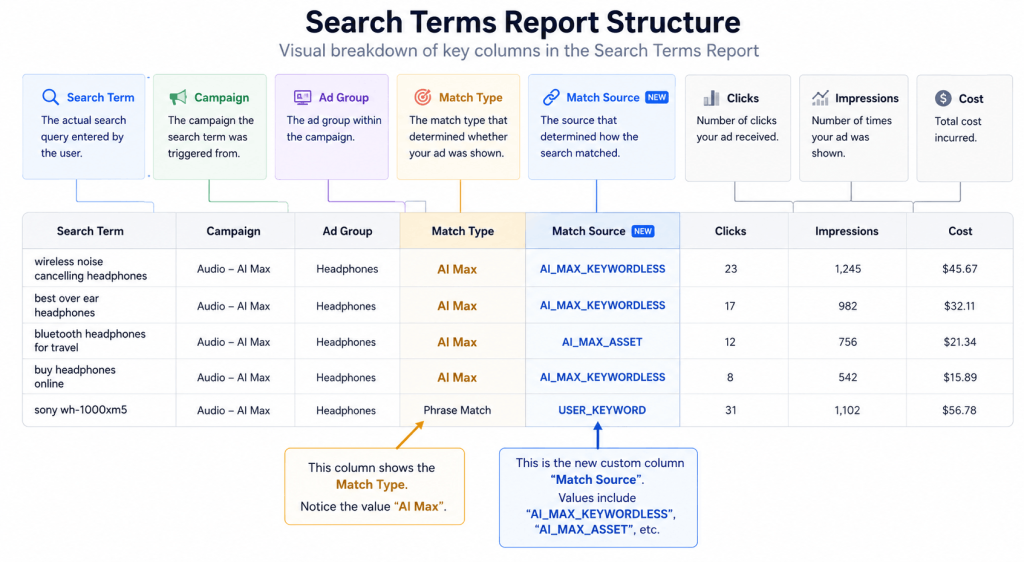
AI Max
AI Max is a Search-only automation layer designed to expand keyword targeting using landing page understanding and real-time query matching.
It behaves similarly to an advanced evolution of Dynamic Search Ads.
Performance Max
Performance Max is a full omnichannel campaign type that distributes ads across:
- Search
- YouTube
- Gmail
- Display
- Discover
- Maps
When evaluating AI Max vs Performance Max, the key distinction is simple:
- AI Max improves Search query expansion
- Performance Max expands reach across Google’s entire inventory
Understanding this difference is critical for budget allocation and reporting accuracy.
Modern Match Type Strategy for 2026
The most effective modern Search accounts usually follow a structure like this:
| Match Type | Primary Role |
| Exact Match | Protect high-converting and brand queries |
| Phrase Match | Capture controlled mid-funnel expansion |
| Broad Match | Scale discovery and conversion volume |
| AI Max | Discover hidden search intent opportunities |
The goal is no longer perfect keyword control.
The goal is feeding Google’s AI enough high-quality conversion data to optimize effectively.
FAQ
Should advertisers still use Exact Match?
Yes. Exact Match remains valuable for protecting brand keywords and high-converting bottom-funnel searches.
Is Broad Match safe now?
Yes — but only when paired with Smart Bidding and reliable conversion tracking.
Can AI Max and Performance Max run together?
Yes, but advertisers should use negative keywords and clear campaign segmentation to reduce overlap.
Should advertisers still build SKAG campaigns?
In most cases, no. Intent-based structures now outperform rigid keyword segmentation.
Final Thoughts
Google Ads match types are no longer simple keyword filters.
Modern Search campaigns are powered by semantic intent modeling, machine learning, and automated bidding systems. Advertisers who continue managing accounts with pre-AI strategies often struggle with inefficiency, limited scale, and fragmented data.
The advertisers seeing the strongest results in 2026 are not obsessing over keyword syntax.
They are building systems that help Google’s AI understand:
- business intent
- conversion quality
- landing page relevance
- audience behavior
That shift — from syntax to intent — is now the foundation of successful google ads management.
Businesses that adapt early to Google’s AI-driven matching systems are already gaining a major competitive advantage in Search.
At Admoon Agency’s Google Ads Management Services, we help brands rebuild outdated PPC structures into modern, AI-optimized campaign systems designed for scalable growth and higher ROAS.
If you’d like a professional audit of your current account structure, conversion tracking setup, or Smart Bidding strategy, our team offers free Google Ads consultations for qualified businesses.