
The Real Question Behind Google Ads Automation
Over the last few years, Google has pushed advertisers aggressively toward automation. Smart Bidding, Broad Match, Performance Max, and AI-driven recommendations are now deeply integrated into nearly every part of the platform.
For many businesses, this creates a difficult question:
Should you fully trust Google Ads Automation with your advertising budget?
The answer is more nuanced than most marketers admit.
Google’s machine learning systems are incredibly effective at processing large amounts of auction data in real time. But automation alone does not understand your profit margins, lead quality, sales process, or long-term business goals.
That is why modern Google Ads Management is no longer about choosing between humans and automation. The real advantage comes from combining machine learning with strategic human oversight.
Why Blind Automation Often Fails
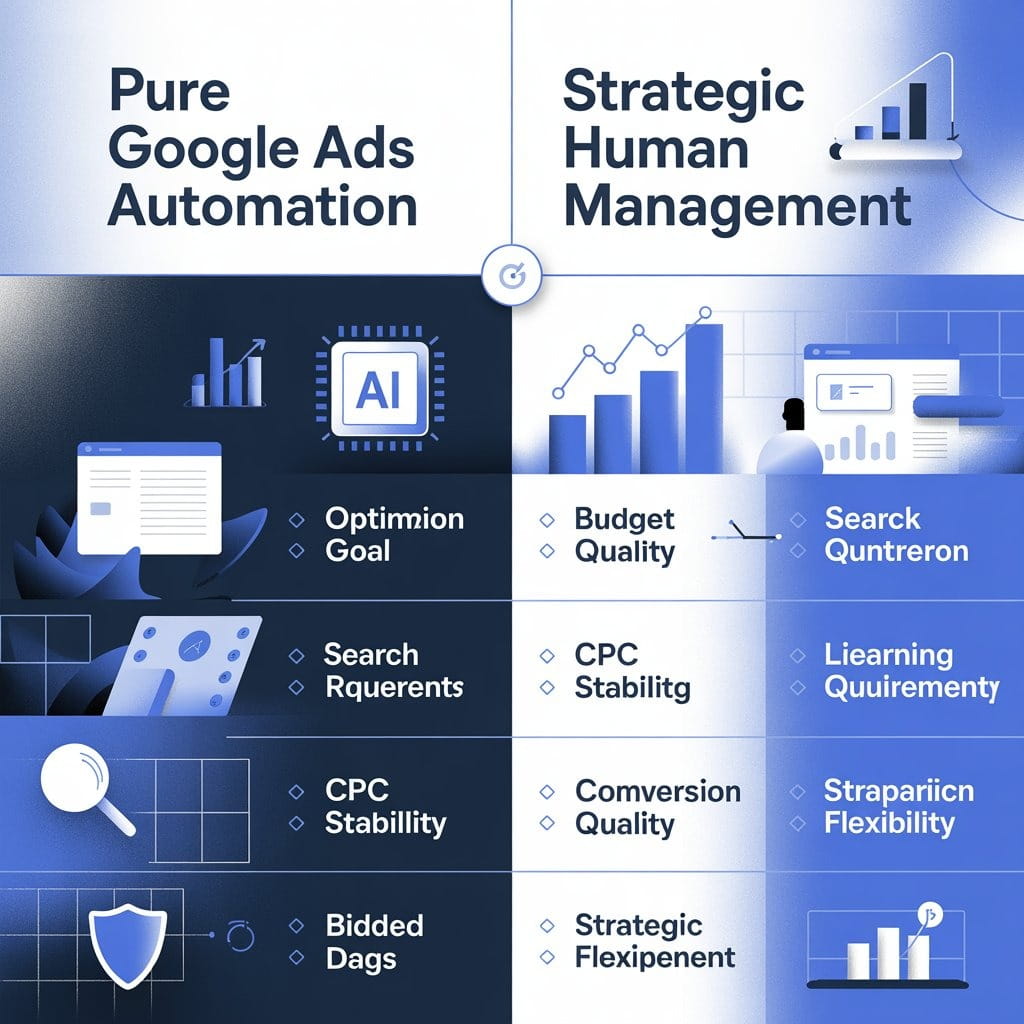
One of the biggest misconceptions in PPC is the belief that Google’s automation systems are designed primarily around advertiser profitability.
In reality, Google’s algorithms are optimized to maximize platform activity:
- more auctions
- more clicks
- more conversion opportunities
- full budget utilization
That does not always align with business profitability.
Many advertisers enable Broad Match and automated bidding without proper controls in place. The result is often inflated traffic, inconsistent lead quality, and unstable acquisition costs.
Across several lead generation accounts audited in 2025, we repeatedly saw automated campaigns increase conversion volume while simultaneously reducing lead quality because the algorithm optimized toward easier, low-intent form submissions.
Automation can scale performance — but only when the underlying signals are clean and strategically controlled.
Where Google Ads Automation Actually Excels
Despite the risks, modern automation is extremely powerful in the right conditions.
Google’s AI evaluates signals that humans simply cannot process fast enough during live auctions, including:
- device behavior
- location signals
- historical search patterns
- audience intent
- time-of-day performance
- conversion probability
This is where automated bidding strategies like Target CPA and Target ROAS become valuable.
In mature accounts with strong conversion tracking and consistent monthly volume, automation often outperforms manual bidding by reacting instantly to auction-level behavior changes.
For ecommerce brands and high-volume lead generation campaigns, machine learning can significantly improve scale and efficiency once enough reliable data exists.
The 30-Conversion Threshold Matters
Automation performs best in data-rich environments.
Most Smart Bidding systems require at least 15–30 meaningful conversions per month before machine learning models stabilize properly.
Without sufficient data, Google’s algorithms struggle to identify patterns confidently. This often leads to volatile CPCs, unstable targeting behavior, and inefficient budget allocation.
That is why experienced PPC managers rarely launch brand-new accounts directly into full automation.
Instead, they first establish:
- conversion tracking accuracy
- search query controls
- audience validation
- landing page quality
- baseline conversion data
Only after this foundation is stable does automation become truly effective.
Even the most advanced machine learning system is not a business strategist.
Automation does not understand:
- product margins
- customer lifetime value
- sales team quality
- operational limitations
- seasonal business priorities
Without human oversight, algorithms can optimize toward misleading performance signals.
For example, if low-value micro conversions are marked as primary goals in GA4, Google may aggressively optimize toward users who are unlikely to generate actual revenue.
This is one of the biggest hidden risks of poorly configured Google Ads Automation systems.
Strong Google Ads Management focuses heavily on signal quality — not just conversion quantity.
The Problem With Full Broad Match Automation
Broad Match has improved dramatically in recent years because of Smart Bidding integration.
However, Broad Match still requires strict supervision.
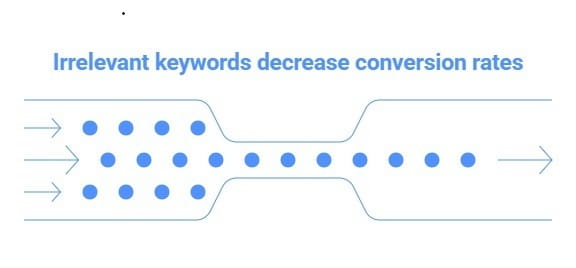
Without negative keyword controls, automated campaigns can expand into loosely related search intent areas that generate clicks but little business value.
This becomes especially dangerous in:
- B2B campaigns
- local service industries
- niche SaaS markets
- high-ticket lead generation
The solution is not avoiding automation entirely.
The solution is building clear control systems around it.
Performance Max: Powerful but Risky
No campaign type represents the automation debate better than Performance Max.
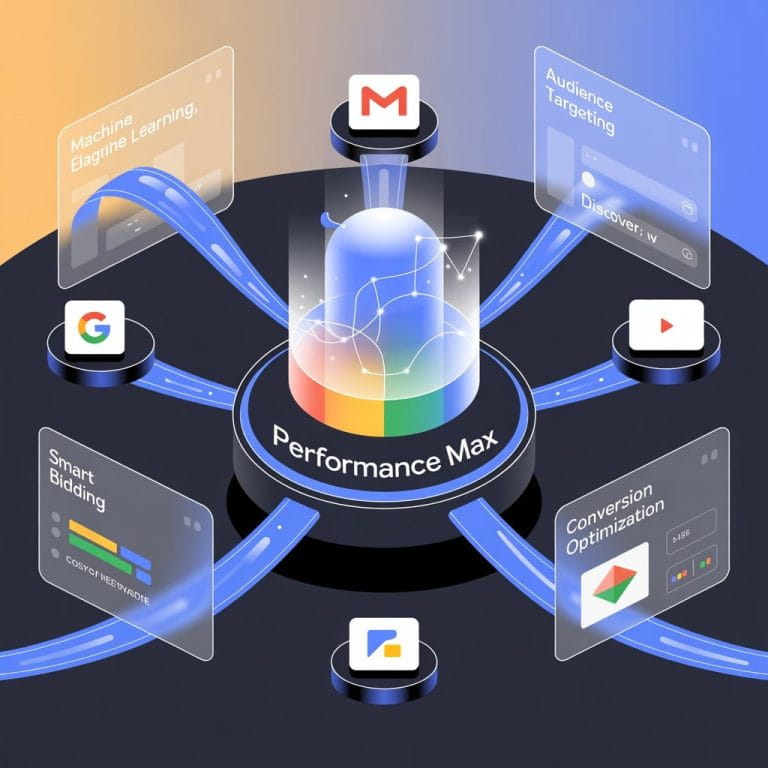
Performance Max combines Search, YouTube, Display, Discover, Gmail, and Maps into one fully automated campaign environment.
For some ecommerce brands, PMax can drive significant growth.
But it also introduces major visibility limitations:
- reduced search term transparency
- limited placement control
- weaker audience insights
- restricted negative keyword management
This “black box” structure makes strategic oversight extremely important.
Professional PPC teams typically manage Performance Max using:
- brand exclusions
- audience segmentation
- asset group structuring
- conversion value rules
- customer acquisition monitoring
Without these safeguards, automation can easily inflate performance metrics while delivering weaker long-term business outcomes.
How Smarter Google Ads Management Controls Automation
The best-performing advertisers today are not rejecting automation.
They are controlling it strategically.
Modern Google Ads Management frameworks usually rely on three core control systems:
1. Bid Limit Protection
Automated bidding systems can occasionally raise CPCs aggressively during competitive auctions.
Portfolio bid strategies and maximum bid limits help prevent uncontrolled spend spikes.
2. Negative Keyword Systems
AdWords optimization remains critical even in AI-driven campaigns, especially regarding negative keyword strategies.
Regular Search Terms Report audits help filter irrelevant traffic and improve intent quality.
3. High-Quality Conversion Signals
Google’s AI only performs as well as the data it receives.
Advanced tracking setups using GA4 and Enhanced Conversions help train algorithms around genuine revenue-driving actions rather than low-value engagement signals.
FAQ
Does automation replace PPC managers?
No. Automation changes the role of PPC specialists from manual bid managers into strategic campaign architects.
Is Smart Bidding safe for small budgets?
Not always. Low-budget campaigns often lack enough conversion data for stable machine learning optimization.
How long does the learning phase last?
Most automated bidding systems require 7–14 days after major changes before performance stabilizes.
Should advertisers avoid Performance Max?
No. Performance Max can perform extremely well when supported by strong conversion tracking and proper campaign controls.
Final Thoughts
Google Ads Automation is neither inherently good nor bad.
Its effectiveness depends entirely on:
- data quality
- campaign structure
- conversion accuracy
- strategic oversight
The advertisers seeing the strongest results in 2026 are not blindly trusting automation — and they are not fighting it either.
They are combining machine learning with disciplined human strategy.
At Admoon Agency’s Google Ads Management Services, we help businesses build scalable PPC systems that combine AI-driven optimization with advanced campaign control frameworks, conversion-focused tracking, and long-term profitability strategies.
If you want a professional review of your current Google Ads setup, our team offers free account audits and strategic consultations for qualified businesses.