

Executive Summary
In the modern digital economy, a Full Funnel Strategy is the practice of mapping Google Ads campaigns to every stage of the buyer’s journey—from initial discovery to final purchase. Rather than focusing solely on “hot leads,” this holistic approach builds brand authority, nurtures intent, and significantly lowers long-term acquisition costs. A professional Google Ads agency leverages this system to transform advertising from a series of “lucky clicks” into a predictable, scalable growth engine.
Introduction: Moving Beyond the “Last-Click” Myth
In the early days of digital marketing, success was simple: buy a few high-intent keywords, drive traffic to a landing page, and collect sales. However, those days are long gone. Today, the average consumer interacts with a brand 7 to 13 times before making a purchase decision. Running isolated, conversion-only campaigns in this environment is a recipe for stagnation.
Focusing exclusively on “direct sales” in Google Ads is like asking for a marriage proposal on a first date. Modern users don’t just “search and buy”; they discover on YouTube, research on blogs, compare on Search, and are finally nudged toward a decision via Remarketing. This is why for any growth-oriented Google Ads agency, the focus has shifted from “managing keywords” to “managing the customer journey.”
Why Consumer Behavior is Becoming Increasingly Complex
The phrase “customer behavior has become complex” isn’t just marketing jargon; it’s a technical reality that every Google Ads agency must navigate. To visualize this complexity, consider a typical user journey:
- Morning: While drinking coffee, a user sees a 6-second YouTube Bumper Ad for your brand (The Spark).
- Afternoon: At work, they remember the name and search for your brand vs. a competitor on their desktop (The Comparison).
- Evening: While commuting, they see a Remarketing Display Ad on a news app offering a 10% discount and finally complete the purchase on their mobile device (The Conversion).
If your agency only targets that final search, you are bidding on the most expensive, most competitive keywords and missing the “assists” that made the sale possible. A Full Funnel Strategy ensures you are present at every one of these micro-moments.
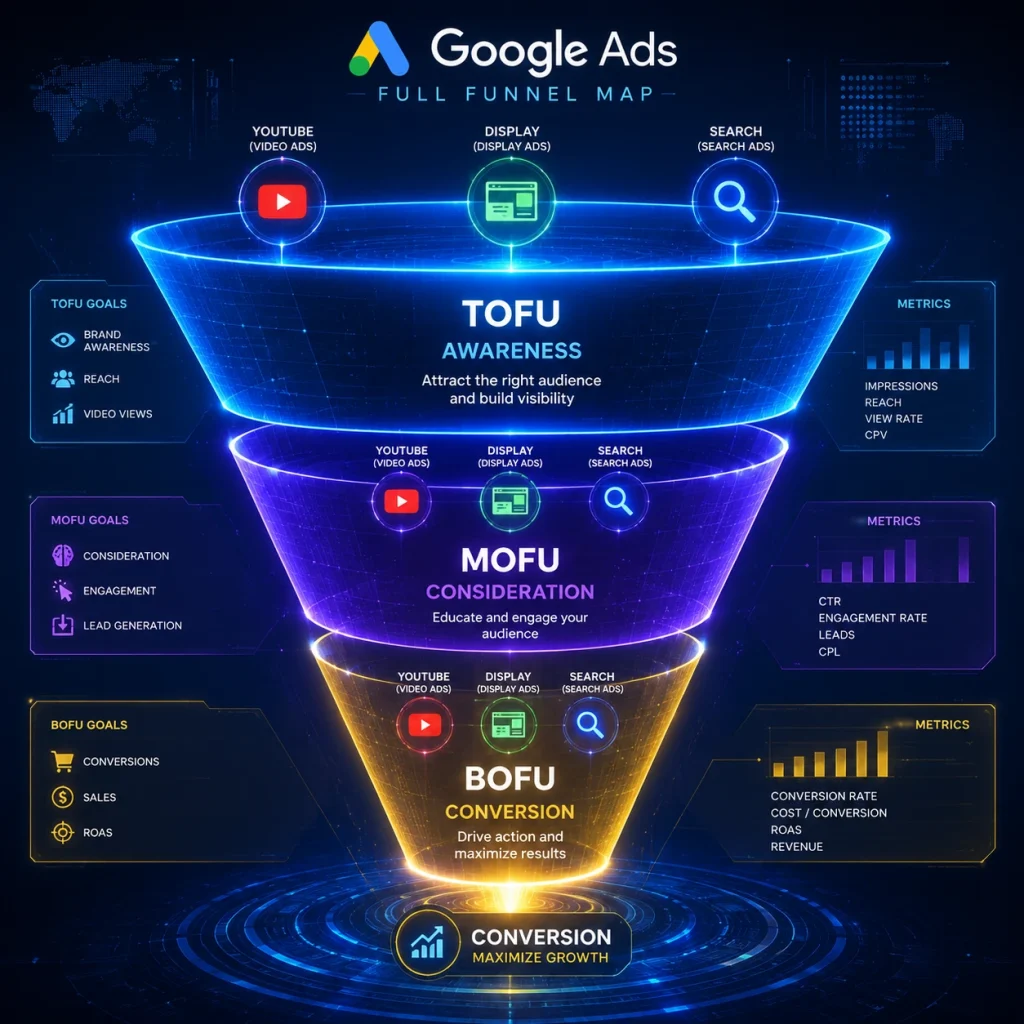
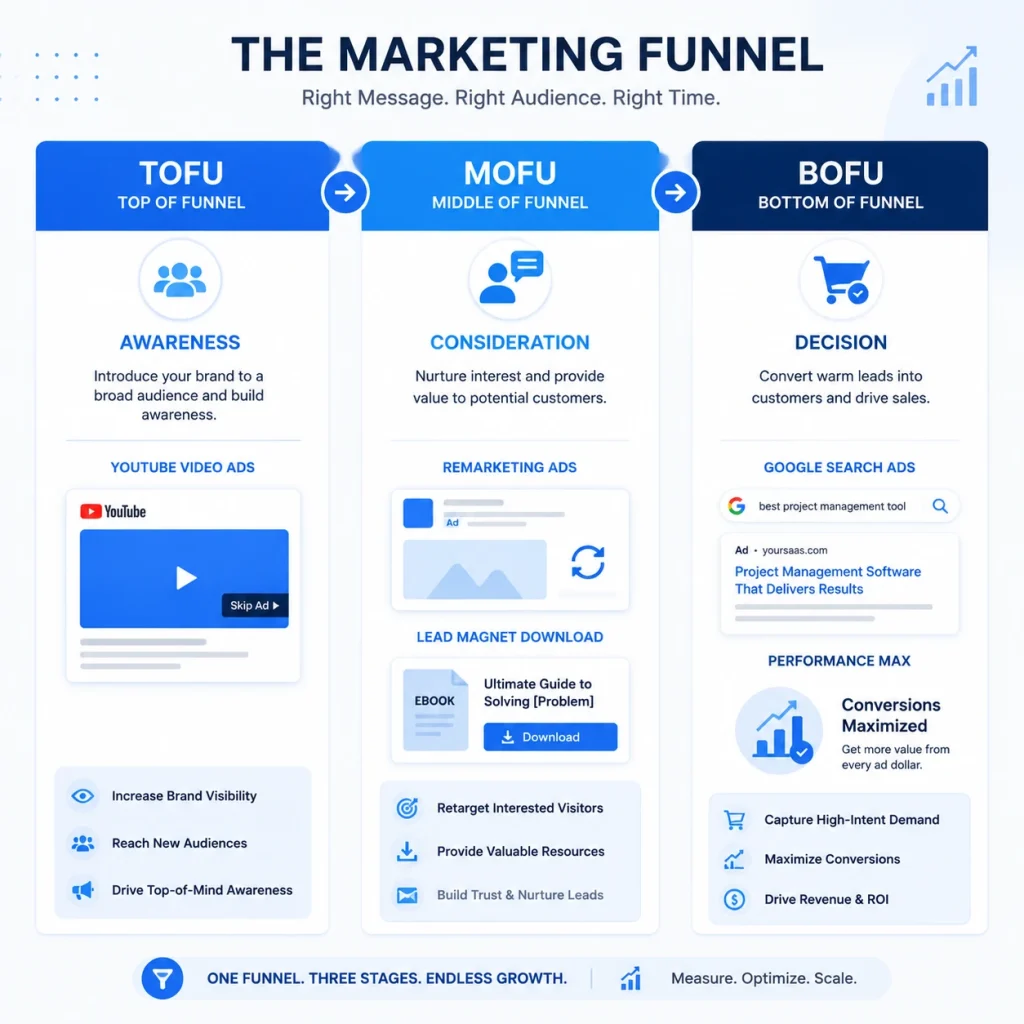
Stage 1: Top of Funnel (TOFU) – Building Awareness
At the Top of the Funnel, your goal is not immediate sales; it is “Mental Availability.” You are reaching people who have a problem but are not yet aware that your brand is the solution.
- Strategy: Focus on storytelling and high-impact visuals. Use “soft” messaging to introduce the brand values rather than product prices.
- Recommended Formats: YouTube Shorts and Demand Gen campaigns are highly effective here due to their low cost-per-reach.
- Key Channels: YouTube Ads, Google Display Network (GDN), and Broad Match Search for high-level industry queries.
- Main KPIs: Unique Reach, CPM (Cost Per Mille), and Video View Rate.
Stage 2: Middle of Funnel (MOFU) – Nurturing Consideration
Once awareness is established, the user enters the consideration phase. They know they need a solution, and they are actively evaluating options.
- Value-Driven Strategy: Instead of pushing for a hard sell, offer value. This is the time to promote a “Free Guide,” a “Product Comparison,” or a “Case Study.” This allows your Google Ads agency to collect micro-conversions (like email signups) which turn “anonymous visitors” into “identifiable leads.” At this stage, leveraging professional Google Ads optimization services ensures campaigns are continuously refined to improve audience targeting, ad relevance, and engagement.
- The Power of Remarketing: Remarketing is the heartbeat of the MOFU stage. By using Audience Segments, you can re-engage users who interacted with your Top-of-Funnel ads with more specific, educational content.
- Main KPIs: Click-Through Rate (CTR) and On-page Engagement Rate.
Stage 3: Bottom of Funnel (BOFU) – Closing the Deal
This is the “Money Stage.” The user has done their research and is ready to buy. Keywords at this stage have high commercial intent, such as “Buy [Product Name] online” or “Best price for [Service]”.
- Conversion Strategy: Frictionless conversion is key. Use strong Calls-to-Action (CTAs), display customer testimonials, and leverage “FOMO” (Fear of Missing Out) with limited-time offers.
- Key Channels: Performance Max campaigns and Search Ads targeting branded and high-intent generic keywords.
- Main KPIs: Conversion Rate and CPA (Cost Per Acquisition).
Why Do Most Full Funnel Strategies Fail? (Common Mistakes)
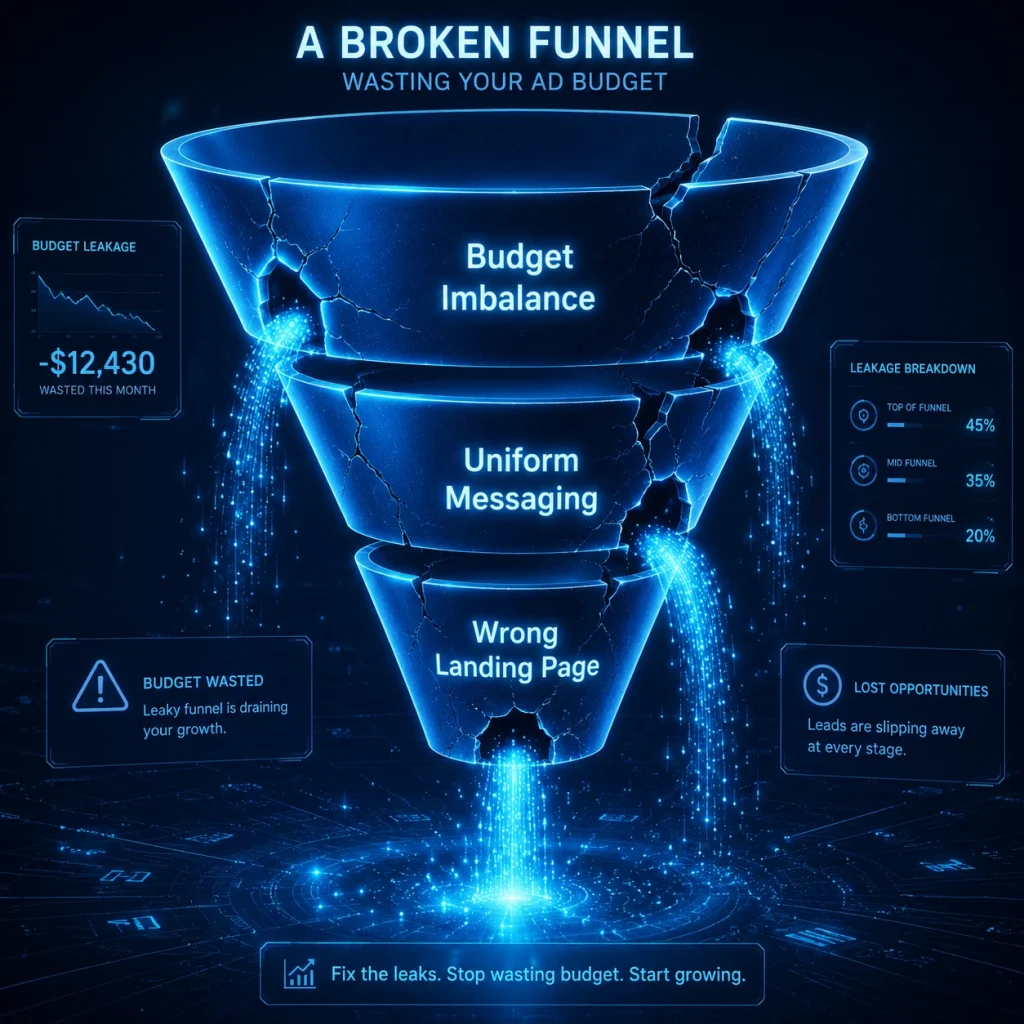
Even with a funnel in place, many businesses fail to see results. A professional Google Ads agency must avoid these three critical errors:
- Budget Imbalance: Allocating 90% of the budget to TOFU without a remarketing system to “close” the sales, or conversely, focusing only on BOFU which eventually exhausts the market of new buyers.
- Uniform Messaging: Using the same “Buy Now” ad for someone who just discovered your brand. Each stage requires a different tone and psychological trigger.
- Ignoring the Landing Page: Sending an “Awareness” visitor to a “Sales” page. If the intent of the ad doesn’t match the landing page, your Bounce Rate will skyrocket.
Real-World Case Study: Achieving a 42% Reduction in CPA
At Admoon, we recently applied this Full Funnel Strategy for a SaaS client struggling with high acquisition costs.
- The Problem: The client only invested in “Buy Software” keywords, resulting in an unsustainable CPA.
- The Full Funnel Solution:
- Awareness: We launched YouTube Ads focusing on “Common Workplace Challenges.”
- Consideration: We retargeted video viewers with a “Free Team Management Checklist.”
- Conversion: We served Search Ads with a “Free 14-Day Trial” only to those who had downloaded the checklist.
- The Result: Within 90 days, lead volume increased by 150%, while the final CPA dropped by 42%.
Essential Tools for Funnel Management
Managing a complex funnel requires more than just the Google Ads dashboard. A top-tier Google Ads agency uses:
- Google Tag Manager (GTM): To track exactly where a user “leaks” out of the funnel.
- GA4 (Google Analytics 4): To analyze Data-Driven Attribution and understand how TOFU ads contribute to final conversions.
- Hotjar: To view heatmaps of landing pages and remove friction points in the conversion stage.
- Looker Studio: To integrate data from all stages into a transparent, real-time ROI report.
The Role of Data-Driven Attribution
In a Full Funnel Strategy, you cannot rely on “Last-Click” attribution. If you do, your TOFU campaigns will always look like they are failing because they don’t get the final credit for the sale. A professional agency uses Data-Driven models to prove the monetary value of every dollar spent on awareness, ensuring your growth engine remains fueled.
Frequently Asked Questions (FAQ)
Is a Full Funnel Strategy suitable for small businesses?
Absolutely. While the budget is smaller, the principle remains the same. Focus heavily on Remarketing to ensure you aren’t wasting your limited budget on “one-off” clicks.
How long does it take to see results?
Because this strategy relies on data collection and audience nurturing, it typically takes 8 to 12 weeks to fully optimize the funnel.
Final Thoughts: Turning Google Ads into a Growth Engine
Implementing a Full Funnel Strategy is not about spending more; it’s about spending smarter. By covering the entire customer journey, you build a brand that doesn’t just “get clicks” but captures market share and builds long-term loyalty.
🚀 Stop Chasing Clicks, Start Building a Journey
Managing a sophisticated funnel is a full-time job that requires constant testing and deep data analysis. At Admoon, we specialize in designing custom full-funnel architectures that deliver sustainable results.
Ready to find out where your current funnel is leaking?
Contact Admoon Today for a Professional Google Ads Audit and Strategy Session.