
Introduction
Student recruitment has evolved significantly over the past decade, with most prospective students beginning their search for degrees, certifications, and training programs online. Consequently, implementing a specialized google ads for educational institutions lead generation strategy has become a cornerstone for institutions looking to capture this digital demand effectively.
For educational institutions, Google Ads offers a powerful way to reach potential applicants when they are actively researching programs and comparing options. Unlike awareness-focused marketing channels, search advertising captures demand at the moment of intent.
However, generating inquiries is only part of the challenge. Educational purchases often involve high tuition costs, lengthy decision-making cycles, and multiple touchpoints before enrollment. Success depends on attracting qualified applicants who are genuinely likely to move through the admissions process.
This guide explores a practical framework for google ads for educational institutions lead generation, covering campaign structure, landing page optimization, audience targeting, lead qualification, and enrollment-focused tracking strategies.
Google Ads for Educational Institutions Lead Generation: Campaign Structure Best Practices
A successful google ads for educational institutions lead generation strategy starts with professional google ads management and a campaign structure that aligns closely with academic programs, student intent, and enrollment goals. The more relevant your campaigns are to specific audiences, the easier it becomes to generate qualified inquiries and reduce wasted advertising spend.
One of the most common mistakes educational institutions make is grouping all programs under a single campaign and sending visitors to a general admissions page.
A prospective MBA candidate has different goals, concerns, and search behavior than someone looking for a short-term certification course. Treating these audiences the same often leads to lower relevance, weaker Quality Scores, and reduced conversion rates.
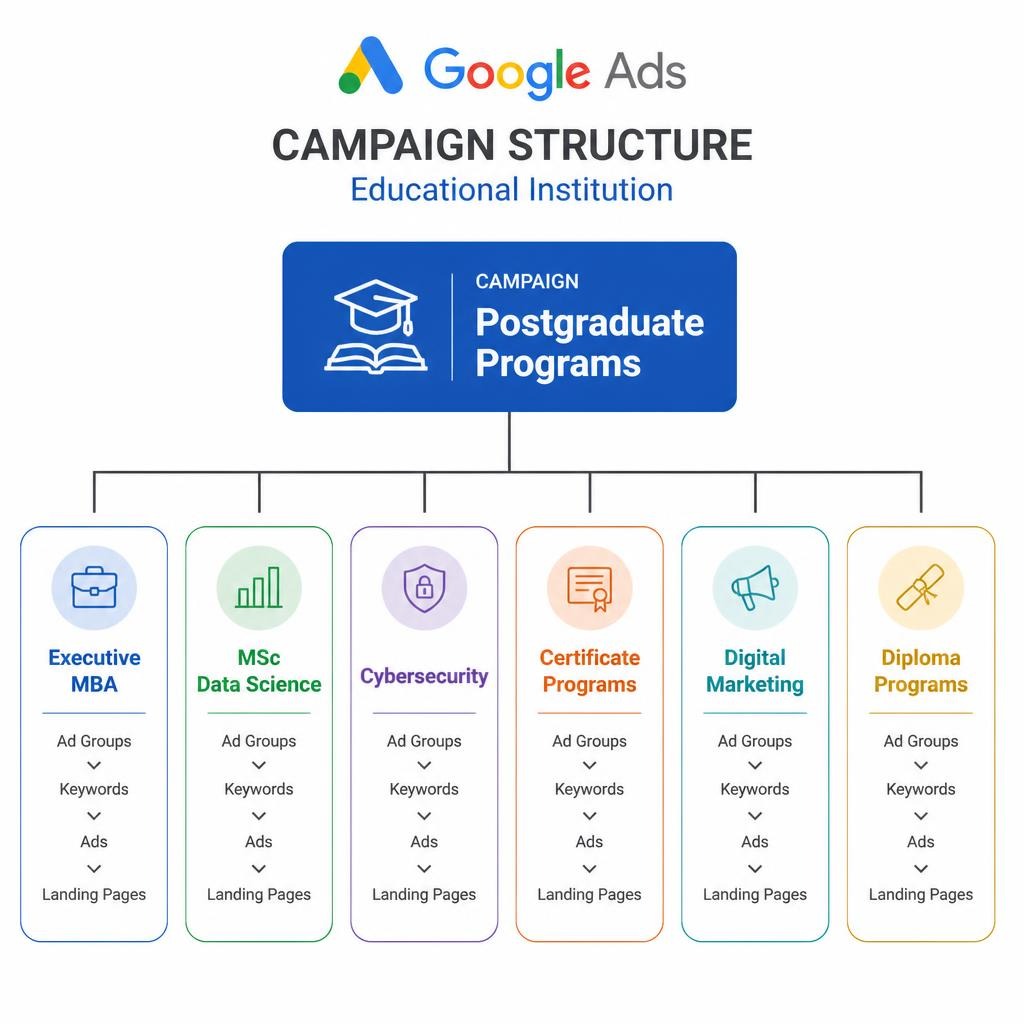
Instead, campaigns should be organized around specific program categories.
Example structure:
Campaign: Postgraduate Programs
- Executive MBA
- MSc Data Science
- MSc Cybersecurity
Campaign: Professional Certifications
- Digital Marketing Certificate
- Project Management Certification
- Business Analytics Program
This structure allows advertisers to create highly relevant ads, landing pages, and keyword groups for each audience segment.
Target High-Intent Educational Keywords
Many institutions waste budget on broad educational searches.
Keywords such as:
- online courses
- university degree
- business school
may generate large amounts of traffic but often attract users who are still exploring options.
Higher-performing campaigns focus on long-tail keywords that indicate stronger enrollment intent:
- executive MBA for working professionals
- online MSc data science program
- cybersecurity certification with career support
- part-time master’s degree in business analytics
These searches usually indicate that a user is already comparing programs rather than casually researching.
Institutions looking to build scalable acquisition systems often rely heavily on dedicated Google Search Ads campaigns because they consistently capture high-intent traffic.
Build a Strong Negative Keyword Strategy
Educational advertisers frequently attract irrelevant traffic from:
- job seekers
- researchers
- students looking for free resources
- users searching for salary information
Common negative keywords include:
- jobs
- internships
- free
- salary
- definition
- project ideas
Regular search term reviews help prevent wasted spend and improve lead quality over time.
Designing Program-Specific Landing Pages That Convert
The quality of your landing page often determines whether a click becomes a lead.
Unfortunately, many educational institutions still direct traffic to generic course directories or homepage experiences that fail to address specific user intent.
Align Landing Pages with Search Intent
Every advertisement should lead to a page directly related to the advertised program.
For example, a user searching for an Executive MBA should land on an MBA-specific page rather than a general admissions section.
Effective landing pages immediately answer key questions:
- What will students learn?
- How long is the program?
- What are the admission requirements?
- What career opportunities may follow?
- What tuition and financing options exist?
Reducing uncertainty helps maintain engagement and improves conversion rates.
Keep Lead Forms Simple
One of the fastest ways to reduce conversions is asking for too much information too early.
For initial lead generation, most institutions only need:
- Name
- Email Address
- Phone Number
- Program of Interest
Additional qualification questions can be collected later through admissions workflows.
Use Social Proof and Trust Signals
Educational decisions involve significant financial and personal commitment.
Strong landing pages should include:
- Accreditation information
- Student testimonials
- Graduate success stories
- Industry partnerships
- Faculty credentials
These elements help answer the prospect’s most important question:
“Why should I choose this institution over another?”
Highlight Career Outcomes Responsibly
Many students evaluate educational opportunities through the lens of career advancement.
Institutions can strengthen landing pages by showcasing:
- Career services
- Alumni outcomes
- Employer partnerships
- Internship opportunities
The key is maintaining transparency and avoiding unrealistic promises.
Choosing the Right Google Ads Campaign Types for Student Recruitment
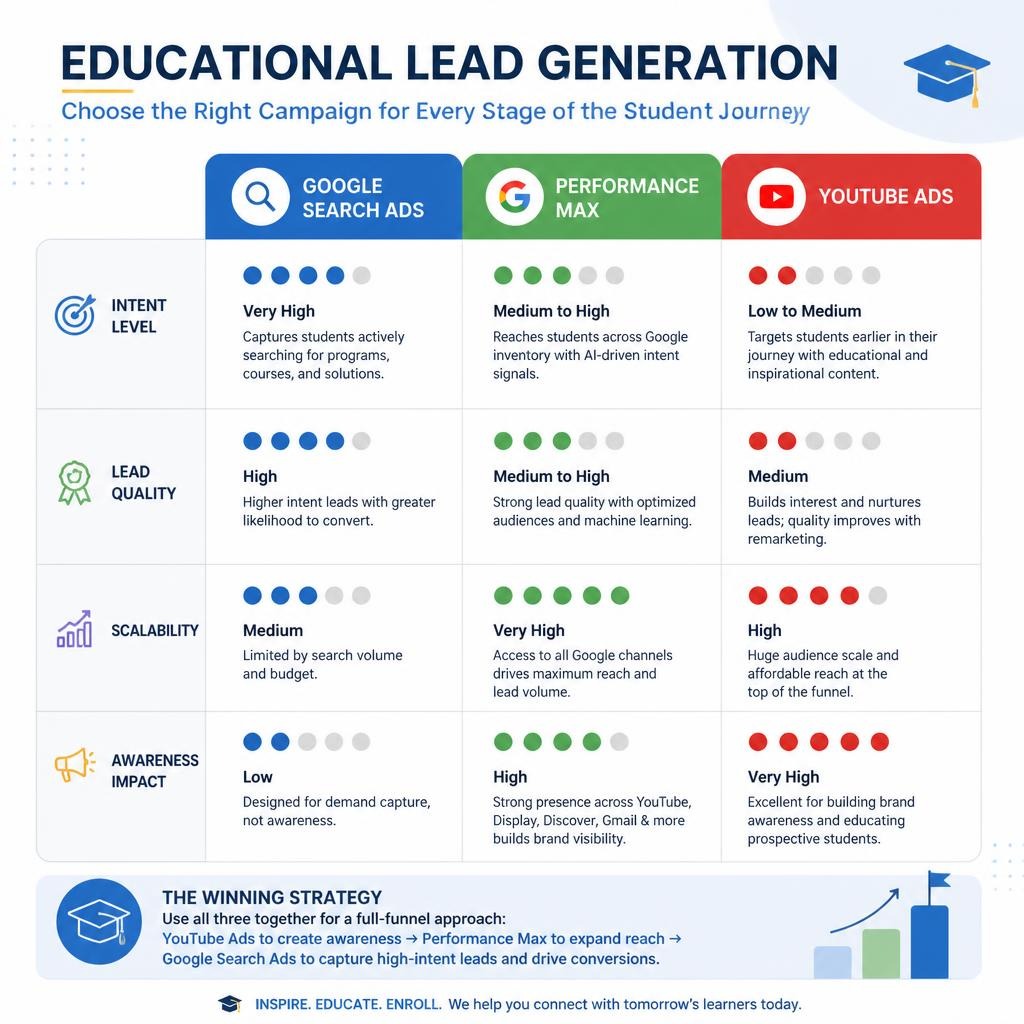
Search campaigns remain the foundation of most successful educational lead generation strategies, but they are not the only option available.
Different campaign types support different stages of the enrollment journey.
| Campaign Type | Best Use Case |
| Search | High-intent enrollment searches |
| Performance Max | Demand expansion and remarketing |
| YouTube | Awareness and application campaigns |
When combined correctly, Search, Performance Max, and YouTube campaigns can create a comprehensive education marketing strategy that supports every stage of the student journey, from awareness to enrollment.
When Search Should Be the Primary Channel
Search campaigns target users actively looking for educational opportunities.
Because users are expressing intent through their search behavior, Search often produces the highest lead quality and strongest conversion rates.
Where Performance Max Supports Growth
Performance Max allows institutions to reach prospects across:
- YouTube
- Display
- Discover
- Gmail
- Search inventory
It can be particularly effective for remarketing visitors who have already engaged with program pages but have not yet submitted an inquiry.
Using YouTube to Influence Enrollment Decisions
Enrollment decisions often involve weeks or months of consideration.
Video campaigns can help reinforce institutional credibility through:
- Campus tours
- Student testimonials
- Faculty interviews
- Application deadline reminders
When used strategically, YouTube supports awareness while Search captures demand.
Optimizing for Student Quality, Not Just Lead Volume
The most effective google ads for educational institutions lead generation campaigns focus on attracting qualified applicants rather than simply maximizing lead volume. Institutions that prioritize enrollment quality often achieve stronger long-term performance and a more sustainable cost per acquisition.
Many educational organizations focus heavily on Cost Per Lead (CPL).
However, generating large numbers of low-quality inquiries rarely produces meaningful enrollment growth.
The goal should be attracting qualified applicants rather than maximizing form submissions.
Define What a Qualified Student Lead Looks Like
Qualified leads typically meet criteria such as:
- Target geography
- Academic eligibility
- Program relevance
- Real enrollment interest
- Appropriate study timeline
Without clear qualification criteria, campaign optimization becomes difficult.
Filter Low-Intent Prospects
Several tactics can improve lead quality:
- Geographic restrictions
- Program-specific forms
- Qualification questions
- CRM-based lead scoring
These measures help reduce inquiries from users who are unlikely to enroll.
Use CRM Data to Improve Campaign Performance
The most sophisticated educational advertisers connect marketing performance with admissions outcomes.
Instead of measuring only lead volume, they evaluate which inquiries eventually become applicants and enrolled students.
| Lead Action | Quality Level |
| Course Inquiry | Medium |
| Prospectus Download | Medium |
| Application Started | High |
| Application Submitted | Very High |
| Enrollment Completed | Highest |
This approach creates stronger optimization signals and improves long-term acquisition efficiency.
Leveraging Behavioral Remarketing and Audience Targeting
Student enrollment rarely happens during a single website visit.
Prospective students often compare multiple institutions, discuss options with family members, and revisit program pages several times before taking action.
Segment Remarketing Audiences by Intent
Not all visitors should receive identical messaging.
Examples include:
- Tuition page visitors
- Application starters
- Webinar registrants
- Program page viewers
Segmenting audiences allows institutions to deliver more relevant messaging throughout the decision-making process.
This is particularly important for higher education lead generation because prospective students frequently compare multiple institutions before making a final decision. Remaining visible throughout the research process can significantly improve conversion rates.
Use In-Market Audiences
Google’s audience signals can help identify users actively researching educational opportunities.
Combining audience targeting with keyword intent often improves campaign efficiency.
Build Custom Segments
Custom segments can target users based on:
- Competitor searches
- Educational websites
- Professional development interests
- Career advancement research
These audiences help expand reach while maintaining relevance.
Connecting Google Ads with Enrollment Data
One of the biggest missed opportunities in educational marketing is stopping measurement at the lead form stage.
A lead is valuable, but enrollment is what ultimately drives institutional growth.
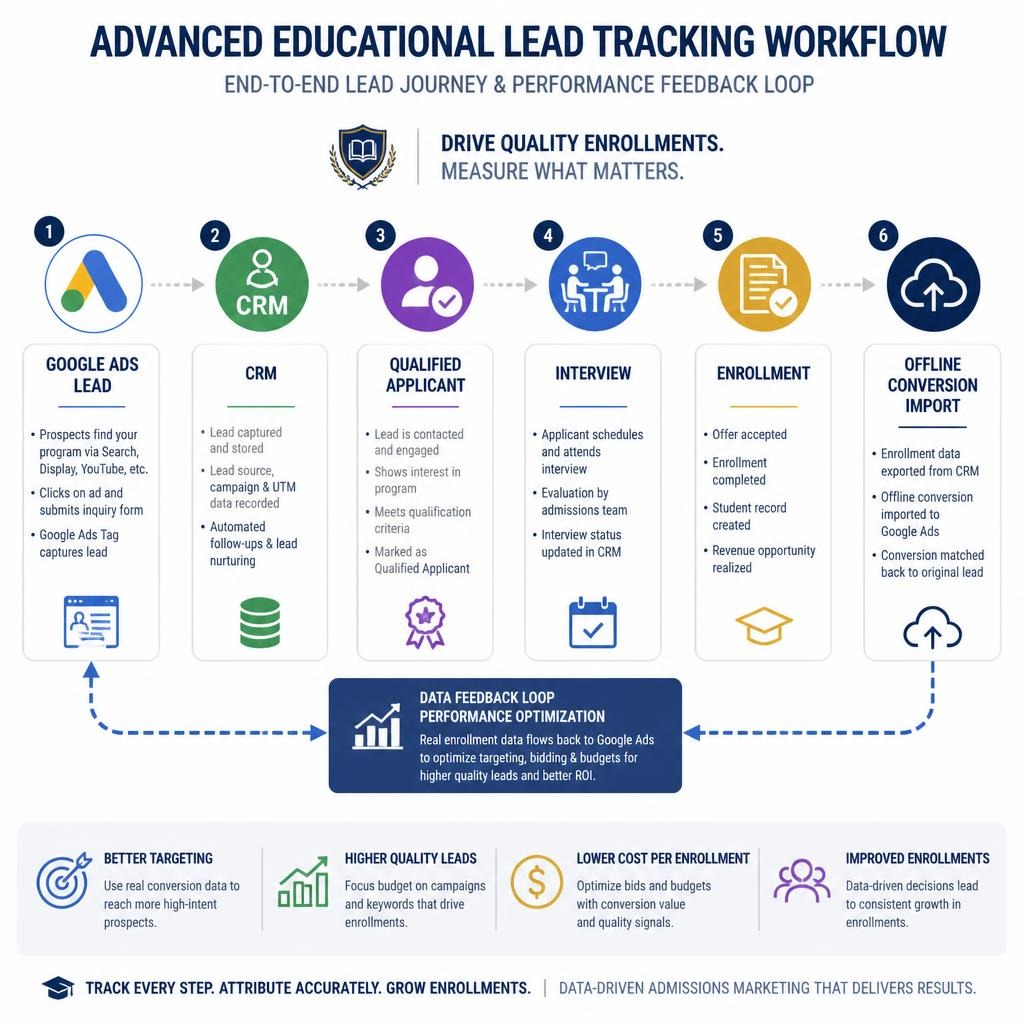
Track the Entire Enrollment Funnel
A typical educational acquisition funnel looks like this:
Google Ads Click
→ Lead
→ Application
→ Interview
→ Enrollment
Each stage provides valuable performance insights.
Use Offline Conversion Import
Many educational advertisers optimize campaigns based solely on lead volume.
However, institutions that connect downstream enrollment data back to Google Ads gain a significant advantage.
By importing qualified applications, interviews, or final enrollments as conversion actions, Google’s bidding algorithms can learn which leads are most likely to become students.
This creates stronger optimization signals than lead forms alone and often improves overall lead quality.
Optimize for Enrollment Outcomes
When enrollment data flows back into Google Ads, campaign optimization becomes significantly more accurate.
Rather than generating the cheapest leads possible, advertisers can focus on attracting the applicants most likely to become enrolled students.
Frequently Asked Questions
Is Google Ads effective for educational institutions?
Yes. Google Ads allows educational institutions to reach prospective students when they are actively researching programs, certifications, and degrees. Search campaigns often generate higher-intent leads than many awareness-focused channels.
Which Google Ads campaign type works best for student recruitment?
Search campaigns typically deliver the highest-intent traffic because they target users actively looking for educational opportunities. Performance Max and YouTube can support awareness, remarketing, and audience expansion efforts.
How can educational institutions improve lead quality?
Lead quality can be improved through program-specific landing pages, qualification questions, geographic targeting, CRM integration, and enrollment-focused conversion tracking.
What should educational advertisers avoid in Google Ads?
Educational advertisers should avoid misleading claims related to employment outcomes, salaries, rankings, scholarships, accreditations, or guaranteed admissions. Transparency is essential for maintaining trust and long-term performance.
Conclusion
Ultimately, successful google ads for educational institutions lead generation depends on combining intent-driven campaigns, high-converting landing pages, precise audience targeting, and continuous Google Ads optimization. Institutions that connect advertising performance with real enrollment outcomes are better positioned to generate sustainable growth and maximize their marketing investment.
Institutions that consistently generate high-quality student inquiries focus on five core areas: campaign relevance, landing page experience, lead qualification, audience targeting, and enrollment-focused measurement.
By structuring campaigns around specific programs, creating dedicated landing pages, leveraging remarketing audiences, and feeding enrollment data back into Google Ads, educational organizations can improve both lead quality and enrollment outcomes.
As competition for prospective students continues to increase, institutions that prioritize qualified applicants over raw lead volume will be better positioned to build sustainable enrollment pipelines and maximize their advertising investment.
For organizations looking to implement more advanced educational institution advertising strategies, a specialized approach can provide a significant competitive advantage in increasingly competitive academic markets.