
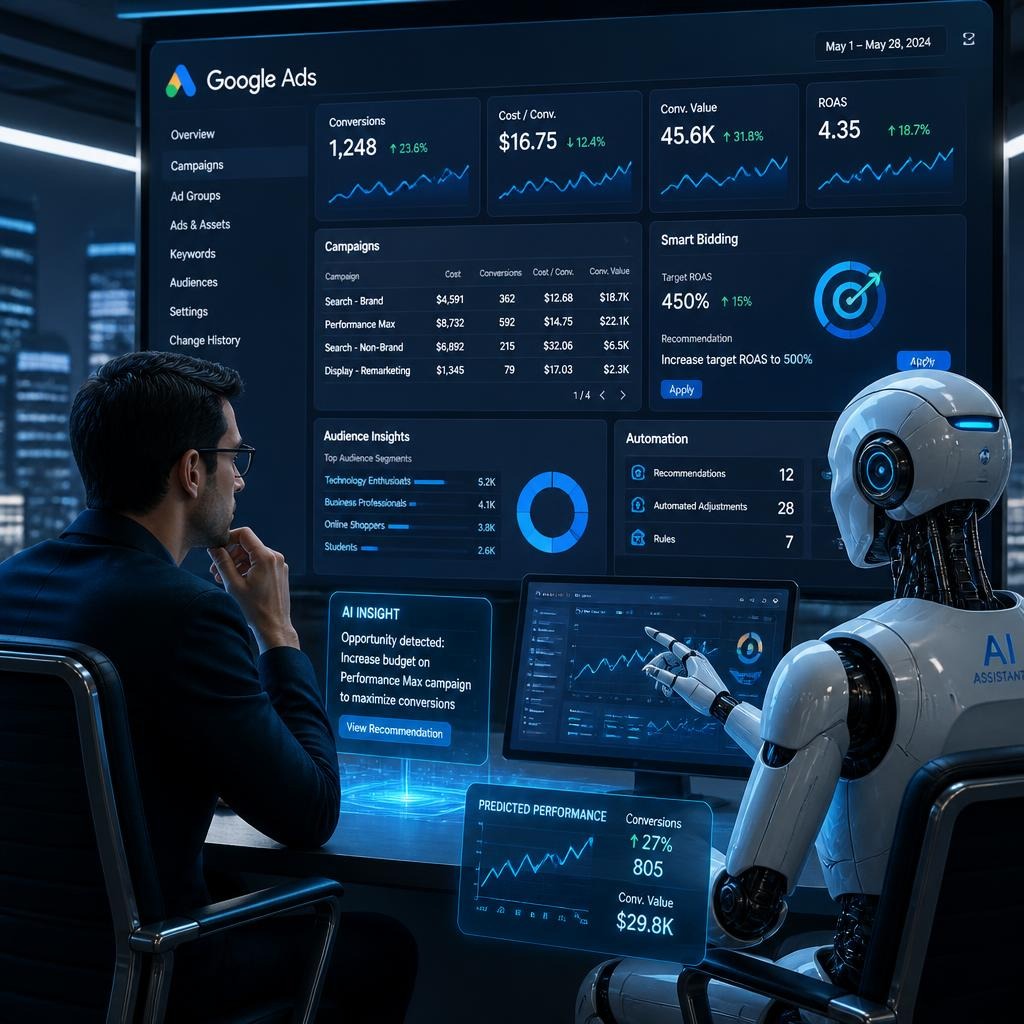
Artificial intelligence is transforming every layer of modern Google Ads management. From bidding and audience targeting to creative generation and campaign analysis, AI now influences nearly every optimization decision. As automation becomes more sophisticated, advertisers must learn how to balance machine-driven efficiency with human strategic oversight.
How AI Is Changing Google Ads Management in 2026: Is It Saving or Spending Your Money?
Google Ads management in 2026 looks nothing like it did just a few years ago. Manual bid adjustments, endless keyword tweaking, and spreadsheet-heavy optimization are rapidly being replaced by AI-driven automation systems that make decisions in real time.
Today, Google’s machine learning models analyze billions of behavioral signals instantly from device type and audience intent to search history and conversion probability. For businesses, this creates one major question:
Is AI actually reducing advertising costs, or is it simply spending your budget faster?
The answer depends entirely on how your campaigns are managed.
Modern AI can dramatically improve campaign optimization, reduce wasted ad spend, and increase ROI when guided by an experienced Google Ads agency. But without proper strategy, first-party data, and human oversight, automated systems can also push budgets into low-quality traffic and inefficient placements.
That’s why businesses increasingly rely on professional Google Ads Management Services to control automation while still benefiting from AI-powered performance improvements.
The Shift From Manual Campaigns to AI-Driven Google Ads Management
In 2026, successful google ads management is no longer about manually controlling every keyword or bid adjustment. Instead, campaign managers now focus on strategic orchestration, audience intelligence, conversion tracking, and data quality.
AI handles the execution layer:
- Smart bidding
- Dynamic audience targeting
- Asset generation
- Predictive budget pacing
- Real-time ad optimization
Humans handle the strategic layer:
- Business goals
- Profitability targets
- Brand safety
- Messaging direction
- First-party data integration
This shift has fundamentally changed how modern PPC management works.
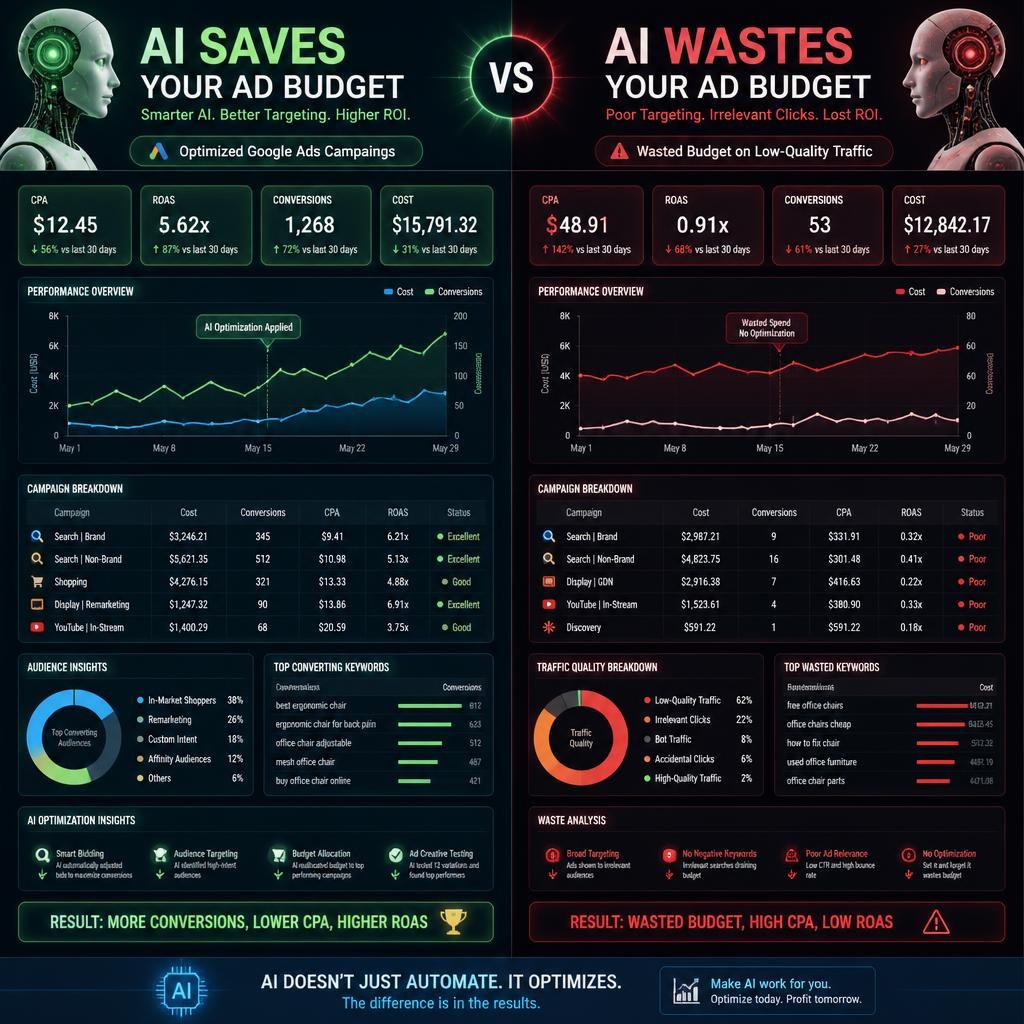
How AI Saves Money in Google Ads Management
When implemented correctly, AI can significantly improve advertising efficiency and lower acquisition costs.
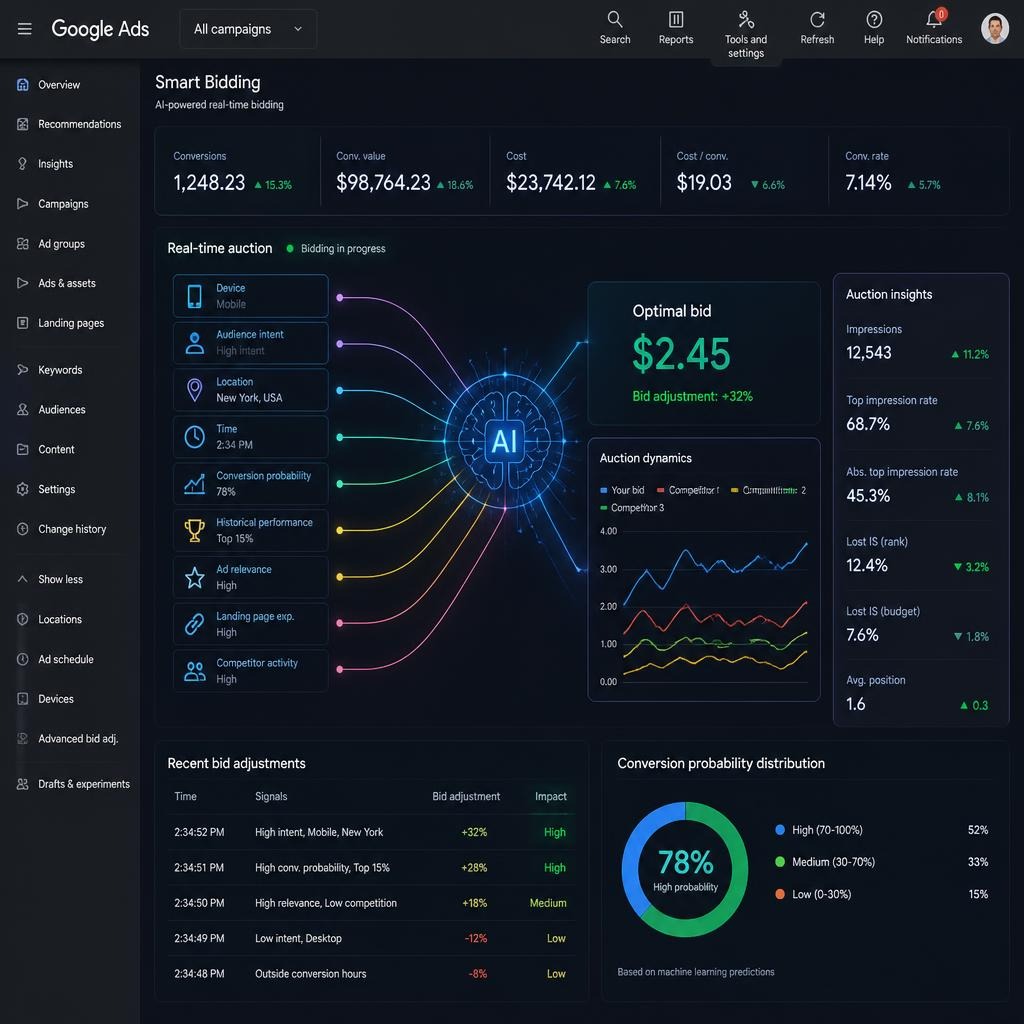
1. Smart Bidding Reduces CPA
Google’s Smart Bidding systems now evaluate dozens of auction-time signals before placing a bid. These include:
- User intent
- Geographic location
- Device behavior
- Search context
- Historical conversion patterns
- Audience signals
Instead of applying one static bid for every click, the algorithm adjusts bids dynamically based on the likelihood of conversion.
The result:
Businesses often see lower CPA (Cost Per Acquisition) and improved ROAS because the system prioritizes high-intent users rather than simply maximizing traffic volume.
For experienced campaign managers, this means less time spent on manual bid adjustments and more focus on conversion strategy.
2. AI Improves Budget Allocation
One of the biggest challenges in google ads management is preventing wasted spend during low-converting periods.
AI-powered budget pacing systems now predict demand fluctuations automatically. Campaign budgets scale up during high-conversion windows and slow down during low-intent traffic periods.
This helps:
- Reduce inefficient spending
- Improve campaign efficiency
- Increase conversion consistency
- Protect limited budgets
For businesses with seasonal demand or fluctuating lead quality, this type of automation can create major profitability improvements.
3. AI Asset Generation Cuts Creative Costs
Creating multiple ad variations used to require constant design and copywriting work. In 2026, Google’s AI asset tools generate:
- Headlines
- Descriptions
- Display creatives
- Video variations
- Audience-tailored messaging
The system analyzes website content, brand tone, and historical performance data to automatically test creative combinations.
This benefits businesses in two ways:
- Lower production costs
- Faster creative testing cycles
More importantly, AI-generated asset combinations often improve CTR because ads adapt dynamically to user behavior and audience intent.
The Biggest Risk: AI Can Waste Budget Without Oversight
Despite the advantages, fully automated campaigns can become extremely expensive when left unmanaged.
AI is designed to optimize toward performance signals — not business profitability. If the system receives weak conversion data or vague strategic instructions, it can easily prioritize cheap traffic over valuable customers.
The Performance Max “Black Box” Problem
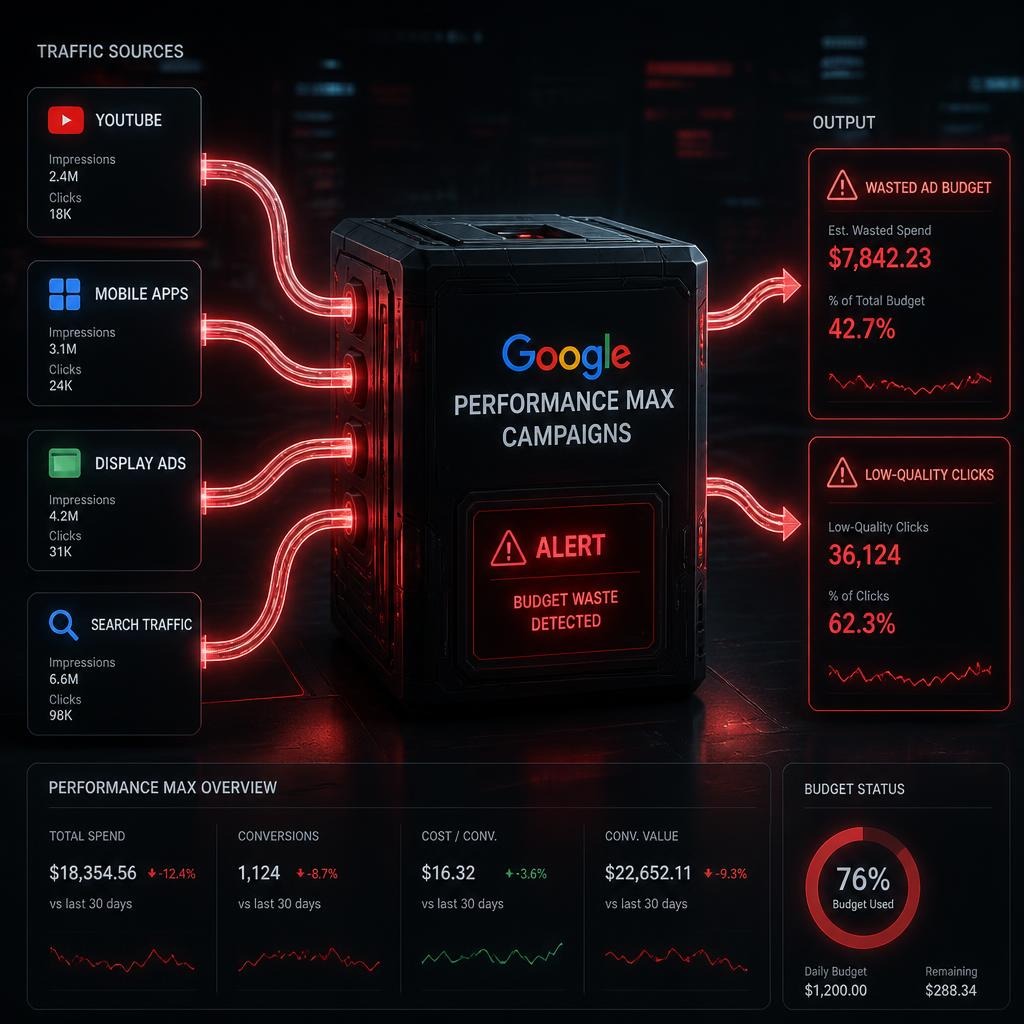
One of the biggest concerns in modern google ads management is the lack of transparency inside Performance Max and AI Max campaigns.
These campaign types distribute ads across:
- Search
- YouTube
- Maps
- Discover
- Display networks
- Partner placements
While automation improves scale, visibility into placement quality is often limited.
The danger:
The system may prioritize lower-cost placements that generate clicks but produce little business value.
Examples include:
- Mobile gaming apps
- Irrelevant YouTube inventory
- Low-quality partner websites
This can inflate click volume while generating weak lead quality and poor conversion performance.
That’s why experienced campaign managers constantly monitor:
- Placement reports
- Audience signals
- Conversion quality
- Brand safety exclusions
- Search term behavior
AI still requires human supervision.
Small Budgets Face a Data Problem
AI performs best when it has strong conversion data.
If an account generates too few monthly conversions, automated bidding systems struggle to understand which users are actually valuable.
This creates what many advertisers call a “data starvation” issue.
For smaller businesses, relying entirely on automation without enough conversion volume can become risky because the system begins making aggressive assumptions using limited data.
In practice:
- CPA becomes unstable
- Budget pacing becomes inconsistent
- Learning phases last longer
- Conversion quality may decline
In these situations, hybrid campaign management often works better than full automation.
Example Scenario: AI-Driven Google Ads Management for a Local Business
The following example represents a realistic scenario illustrating how AI-powered optimization can improve campaign efficiency when paired with proper strategic oversight.
Imagine a local dental clinic running Google Ads with a limited monthly budget.
Without AI optimization:
- Ads run evenly all day
- Bids stay static
- Generic messaging appears to every user
- Budget burns quickly during low-converting hours
With AI-powered campaign optimization:
- Smart bidding prioritizes high-converting time periods
- Ads dynamically highlight emergency appointments for urgent searches
- Returning users receive different messaging than first-time visitors
- Budget shifts automatically toward higher-converting audiences
The result is not necessarily more clicks — but more qualified leads and lower acquisition costs.
This is where strategic google ads management becomes essential: controlling automation instead of blindly trusting it.
New AI Features Businesses Must Watch
Conversational Search Ads
Search behavior is shifting away from short keywords toward natural conversational queries.
Google’s conversational AI experiences now integrate sponsored recommendations directly inside AI-generated responses.
This changes campaign optimization dramatically because advertisers must focus more on:
- Intent signals
- Contextual relevance
- Audience behavior
- First-party customer data
Traditional keyword-only strategies are becoming less effective.
Native Checkout Experiences
Google is also reducing friction between ads and purchases.
With newer AI-driven commerce integrations, users can increasingly complete purchases directly inside Google-powered experiences instead of navigating through multiple checkout pages.
For advertisers, this can improve:
- Conversion rates
- Mobile purchase completion
- Lead quality
- Revenue efficiency
Reducing friction is becoming one of the most important elements of modern PPC management.
AI Account Auditing Tools
Google’s AI advisor systems now provide simplified performance analysis using natural language prompts.
Advertisers can ask questions like:
- “Why did my CPA increase this week?”
- “Which asset group is underperforming?”
- “Where is wasted spend coming from?”
This makes campaign analysis more accessible for business owners while improving transparency across account performance.
How to Prevent AI From Wasting Your Budget
To keep automation profitable, businesses should establish clear operational guardrails.
Use Strong Conversion Tracking
AI is only as accurate as the data it receives.
Poor tracking leads to poor optimization decisions. Accurate conversion tracking, CRM syncing, and offline conversion imports are now essential for effective google ads management.
Feed the Algorithm First-Party Data
Connecting customer data helps Google identify high-value audiences faster.
Using:
- CRM integrations
- Customer Match lists
- Audience signals
- Purchase history
- Lead quality scoring
allows the algorithm to optimize toward profitable customers rather than cheap clicks.
Monitor Brand Safety and Placements
Even highly automated campaigns need placement exclusions and quality control.
Regular monitoring helps eliminate:
- Spam placements
- Low-quality mobile apps
- Irrelevant traffic sources
- Inefficient audience segments
Automation works best with boundaries.
FAQ
Can AI fully replace a Google Ads manager?
No. AI automates execution, but it cannot replace strategic thinking, profitability analysis, or business decision-making. Human oversight remains critical.
Is manual google ads management still important?
Yes. While automation handles many tactical tasks, manual strategy, audience analysis, and budget control are still essential for long-term profitability.
What is the minimum data needed for AI bidding?
Most automated bidding systems perform best when campaigns generate consistent monthly conversions. Low-data accounts often require hybrid optimization strategies.
How can I stop AI from wasting ad spend?
Use accurate conversion tracking, first-party customer data, brand safety exclusions, and regular campaign monitoring to maintain control over automated systems.
How is AI changing Google Ads management in 2026?
AI is automating many tactical aspects of campaign management, including bidding, audience targeting, creative testing, and budget allocation. However, human expertise remains essential for strategy, data quality, and profitability decisions.
Conclusion
AI is no longer optional in google ads management. In 2026, automation powers nearly every aspect of campaign execution, from bidding and audience targeting to creative testing and budget pacing.
But AI alone is not a growth strategy.
Without strong data, proper oversight, and clear profitability goals, automated systems can easily waste advertising spend. Businesses that succeed are the ones that combine machine learning efficiency with human strategic direction.
The future of google ads management belongs to advertisers who understand how to guide AI not simply hand over control to it.
For businesses investing in long-term growth, successful Google Ads management in 2026 is no longer about choosing between automation and human expertise. Instead, it depends on effective AdWords optimization that combines AI-driven optimization with strategic oversight, high-quality data, and continuous performance monitoring.