
Picture two Google Ads agencies. Same city. Same industry. One consistently delivers profitable campaigns. The other keeps accounts running but never quite breaks through. The difference rarely comes down to who works harder. It comes down to the systems built around the work.
In 2026, the gap between a Google Ads agency that performs and one that just exists has never been wider. The top tools in Google Ads agencies are a big part of what creates that gap — the infrastructure, workflows, and decision-making frameworks that quietly power everything behind the scenes.
The Environment Every Google Ads Agency Is Operating In
Google Ads has changed more in the last three years than in the decade before that. Automation is deeper. AI is embedded everywhere. The old model of manually reviewing every keyword bid every morning is gone for any Google Ads agency managing accounts at real scale.
What has not changed is the need for human judgment. As automation handles more of the execution layer, strategic thinking has become more valuable than ever. The top tools in Google Ads agencies today reflect exactly that balance. Here is what it looks like in practice.
1. Google Ads Editor: The Unglamorous Workhorse Every Agency Relies On
There is nothing exciting to say about Google Ads Editor. It has existed for years. No sleek dashboard, no trendy interface. And yet, walk into any serious Google Ads agency and you will find it open on half the screens.
The reason is speed and control. When managing dozens of client accounts and needing to push bulk changes or restructure campaigns, Editor is still the fastest way to do it safely — offline, reviewed before publishing, executed without touching the live interface. It never appears in pitch decks, but disappearing from the workflow would immediately slow everything down.
2. Optmyzr: Where Automation Gets Intelligent
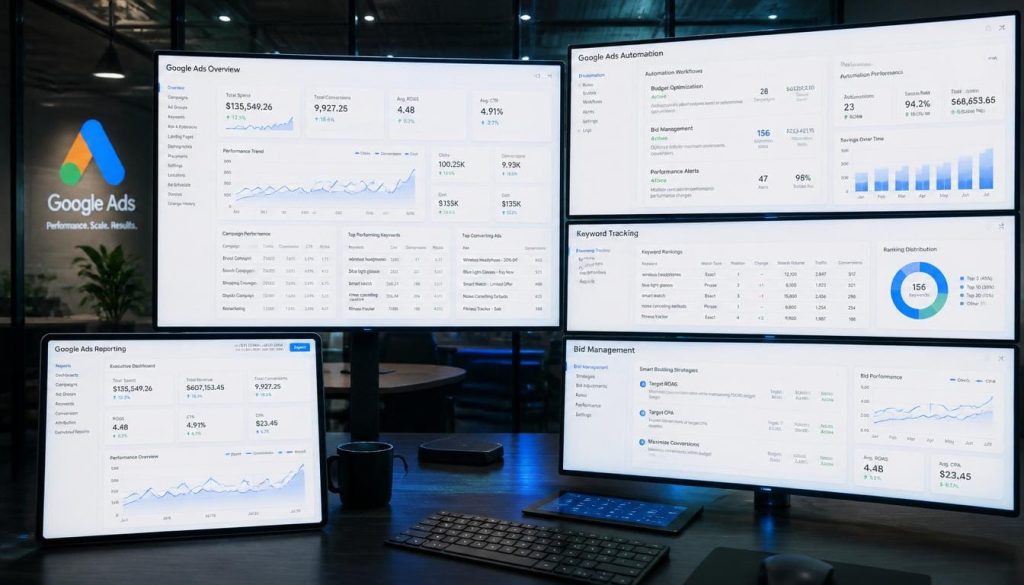
Most automation tools offer a simple idea: set a rule, let it run, save some time. Optmyzr is built around something different. It is designed for Google Ads agencies that want automation that adapts to actual performance behavior — pausing keywords when CPA climbs past target, shifting budgets toward campaigns that are hitting numbers, flagging anomalies before clients notice them.
The result is not a replacement for human strategy. It is a layer underneath it that handles repetitive execution — so experienced people can focus on decisions automation cannot make. For a Google Ads agency managing twenty or fifty accounts, this is what makes consistent quality possible at scale.
3. SEMrush: Competitive Intelligence That Changes How Campaigns Get Built
In paid search, the competitive landscape is not invisible — it is just overlooked by agencies that never bother to study it. SEMrush gives a Google Ads agency a window into how competitors are bidding, what ad copy they have been running for months, and where gaps exist that a smarter campaign could exploit.
Among the top tools in Google Ads agencies, SEMrush stands out because it improves decisions at every stage — not just at the start. Better Quality Scores, sharper messaging, landing pages aligned with real search intent. It is competitive intelligence that shows up directly in campaign performance.
4. Looker Studio: Reporting That Actually Builds Client Trust
Clients do not leave because results are bad. They often leave because they cannot tell whether the results are good. Agencies that paste Google Ads numbers into a PDF are creating more questions than answers. Clients see data. They do not see performance.
Looker Studio connects Google Ads, GA4, Search Console, and other sources into dashboards that tell a coherent story. When a client genuinely understands what is happening in their account, the relationship changes. The agencies with the lowest churn rates are almost always the ones with the clearest reporting.
5. Adalysis: Testing as a System, Not an Afterthought
Most Google Ads agencies run some version of ad testing. Very few run it in a way that produces reliable conclusions. Adalysis is built for agencies that take it seriously — tracking not just which ad performed better, but whether that result is statistically meaningful and when creative fatigue is setting in.
Ad fatigue is real and predictable. Adalysis keeps agencies ahead of the performance drop before it becomes a conversation a client has to initiate. It also catches account health issues across large portfolios — disapproved ads, weak structures, missing test variations — before anything breaks.
6. Performance Max and Smart Bidding: Google’s AI, on Your Terms
No list of top tools in Google Ads agencies in 2026 is complete without addressing what Google itself has built into the platform. Performance Max runs across Search, Display, YouTube, Gmail, Maps, and Discover simultaneously — and it either performs remarkably well or burns budget, almost entirely depending on how it is set up.
Clean conversion tracking, strong audience signals, and well-organized creative assets are the foundation that determines whether Performance Max campaigns deliver results or just spend money. The agencies winning with Google’s AI are not the ones who hand everything over to automation. They are the ones who treat it like a collaboration.
What to Look for When Hiring a Google Ads Agency
If you are evaluating a Google Ads agency, asking about tools is a reasonable starting point. But the follow-up question matters more: how are those tools actually used? Any agency can list software they subscribe to. What you want to understand is the system behind it — how optimization happens, how testing works, how performance gets communicated.
The top tools in Google Ads agencies only create value when experienced people are using them with clear processes and real accountability.
The Bigger Picture
The tools covered here — Google Ads Editor, Optmyzr, SEMrush, Looker Studio, Adalysis, Performance Max — are not magic. They are infrastructure. What matters is not whether you have them, but whether you have built something worth supporting on top of them.The best Google Ads management in 2026 looks like a precision operation where automation handles execution, data informs strategy, and human judgment stays focused on decisions that actually drive growth. That combination — the right top tools in Google Ads agencies, used with discipline — is what separates the agencies building real results from the ones just keeping the lights on.